Why Your Funnel Is Built for a Business You’re Not
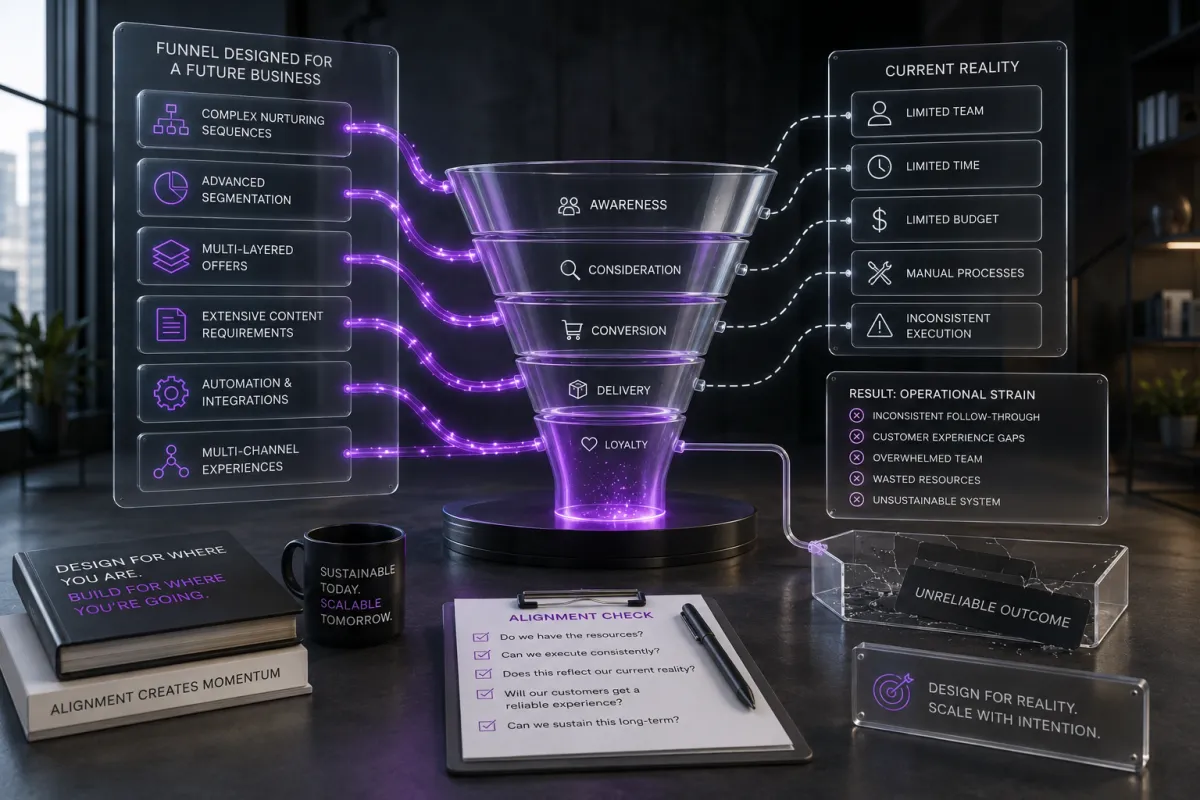
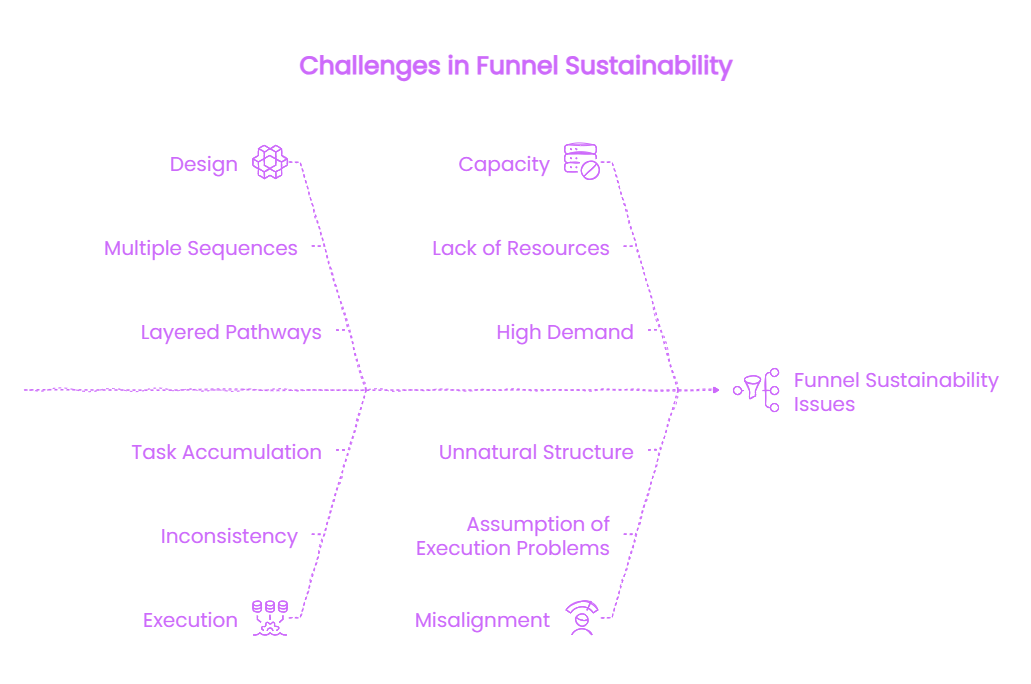
Funnels that appear sophisticated on paper are not always sustainable in practice. The structure may look strategic, comprehensive, and well developed from the outside. Multiple sequences, layered pathways, advanced automation, and extensive content assets may all be present. Yet operating the funnel often feels heavier than expected once execution begins. The team struggles to maintain consistency across the system over time. Tasks accumulate faster than they can be completed effectively. The funnel begins demanding a level of capacity the business does not yet possess.
This experience frequently creates confusion because the funnel itself appears correct. Business owners often assume the problem exists within execution rather than design. More effort is applied in an attempt to make the system function as intended. Additional resources are invested to sustain processes that continually create strain. Over time, maintaining the funnel becomes exhausting rather than productive. The structure feels increasingly unnatural despite appearing sophisticated externally. The issue is not ambition, but misalignment between the funnel and the current reality of the business.
What This Misalignment Actually Is
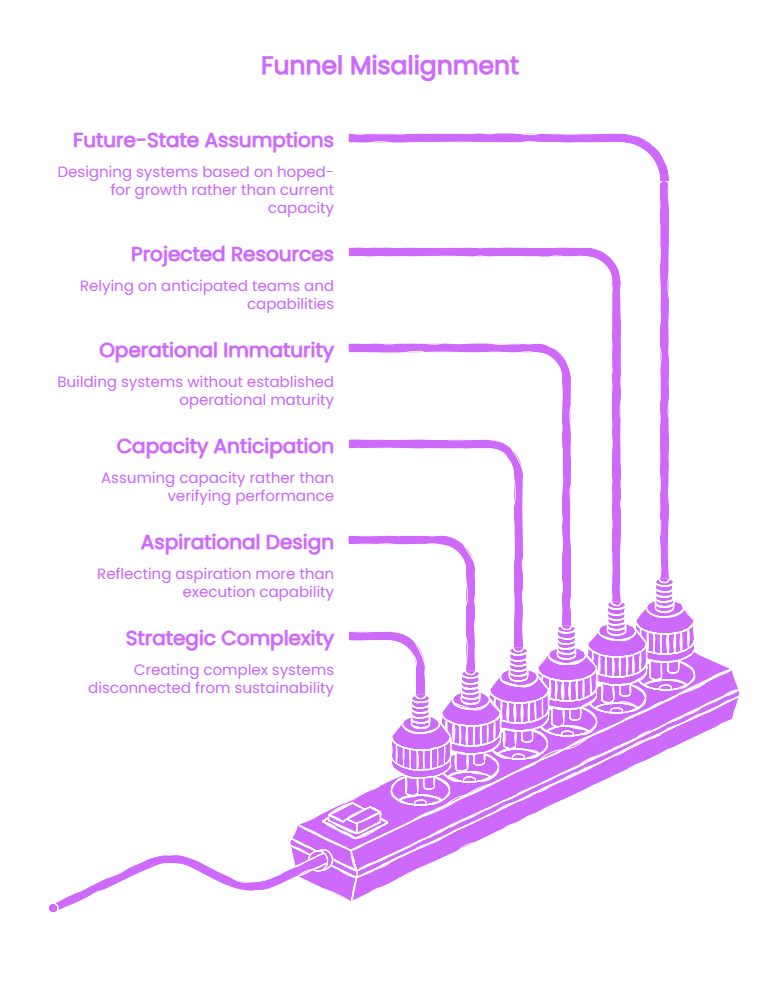
This misalignment occurs when funnels are designed around future-state assumptions rather than present operational capacity. The system is built for the business the owner hopes to become rather than the business that currently exists. Strategic decisions are based on projected resources, projected teams, and projected capabilities. The funnel assumes operational maturity that has not yet been established consistently. Capacity is anticipated rather than verified through current performance and infrastructure. As a result, the funnel becomes dependent upon conditions that are not reliably available. The structure is optimized for a business that does not yet exist.
This often happens because businesses naturally look toward growth while designing systems. They study organizations operating at larger scales and attempt to replicate similar structures. They adopt frameworks designed for teams, budgets, and resources beyond their current reality. What appears sophisticated externally may be unsupported operationally behind the scenes. The funnel begins reflecting aspiration more than execution capability. Strategic complexity becomes disconnected from practical sustainability. The result is a system that continually exceeds the capacity available to support it.
What It Looks Like in Practice
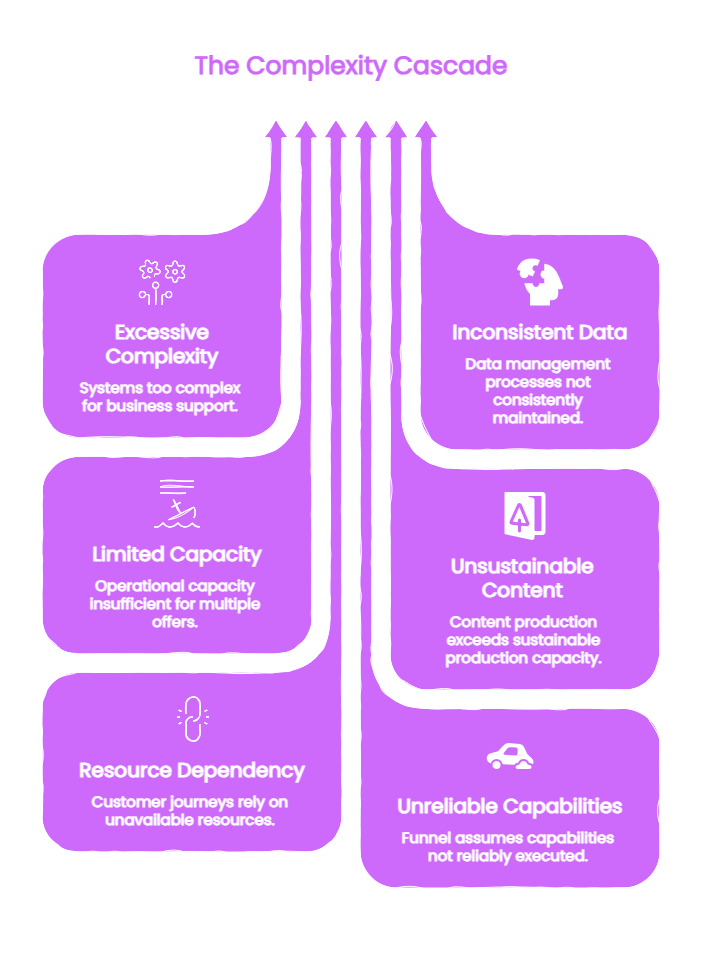
In practice, this distortion often appears through systems carrying more complexity than the business can realistically support. The funnel may contain extensive nurturing sequences designed for teams that do not exist. Advanced segmentation may require data management processes that are not consistently maintained. Multiple offers may be layered together despite limited operational capacity to support them effectively. Content requirements may expand far beyond what can be produced sustainably over time. Customer journeys become increasingly dependent on resources that remain unavailable or inconsistent.
The funnel assumes capabilities that cannot be executed reliably. This creates a growing gap between design and reality throughout the system. Tasks begin accumulating because execution requirements exceed available capacity. Processes become partially implemented rather than consistently maintained. Customer experiences vary because operational consistency cannot be sustained at every stage. Teams spend increasing amounts of time managing complexity rather than creating clarity. The funnel appears sophisticated while functioning inconsistently beneath the surface. What was intended to support growth begins creating operational strain instead.
How Funnels Reveal This Distortion
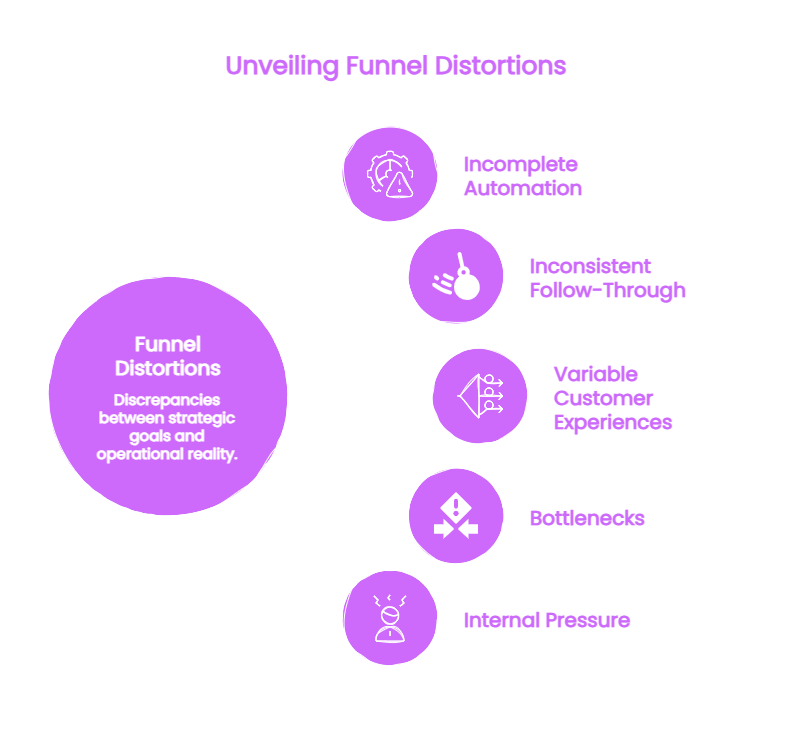
Funnels reveal this distortion through breakdowns that emerge during execution rather than design. Automation sequences remain unfinished because supporting systems are incomplete. Follow through becomes inconsistent because operational requirements exceed available resources. Customer experiences begin varying depending on which parts of the system are actively maintained. Bottlenecks emerge where complexity requires more capacity than currently exists. Internal teams experience increasing pressure to sustain processes that were designed beyond their reality. The funnel exposes the difference between strategic aspiration and operational readiness.
These breakdowns often appear gradually rather than all at once. Individual gaps may initially seem isolated and manageable. Over time, however, recurring strain begins appearing across multiple areas of the system. Execution becomes reactive because maintaining the structure requires constant intervention. Customer experience quality may fluctuate despite strong intentions and thoughtful design. The funnel continues revealing points where operational reality cannot consistently support strategic complexity. The system exposes capacity limitations that design alone cannot overcome.
Why More Sophistication Doesn't Fix It
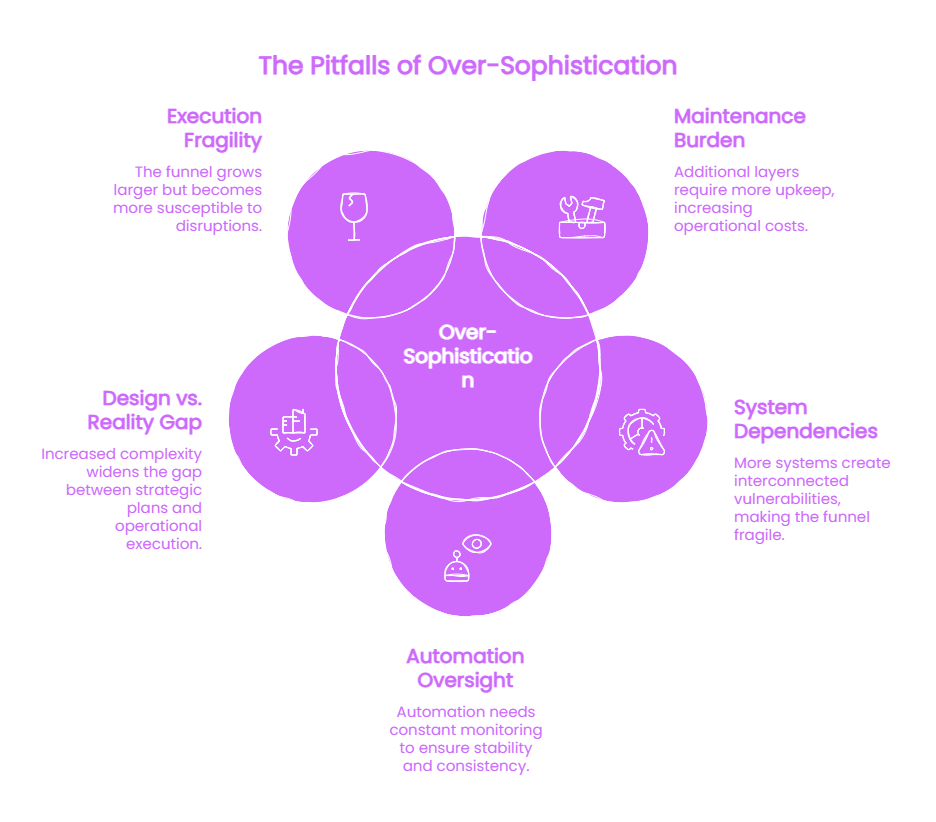
Attempts to resolve this problem often involve adding additional sophistication to the funnel itself. More automation is introduced in an effort to reduce operational pressure. Additional workflows are layered into the system to manage existing complexity. New tools are implemented to coordinate increasingly complicated processes. More content, more segmentation, and more pathways are added to improve performance. However, complexity cannot compensate for a lack of operational readiness. In many cases, additional sophistication amplifies existing strain.
This occurs because every new layer introduces additional maintenance requirements. More systems create more dependencies throughout the funnel. More automation requires more oversight to ensure stability and consistency. Additional complexity expands the distance between design assumptions and operational reality. What appears strategically advanced may become increasingly difficult to sustain over time. The funnel grows larger while execution becomes more fragile. Complexity magnifies misalignment rather than resolving it.
Where Alignment Must Be Established
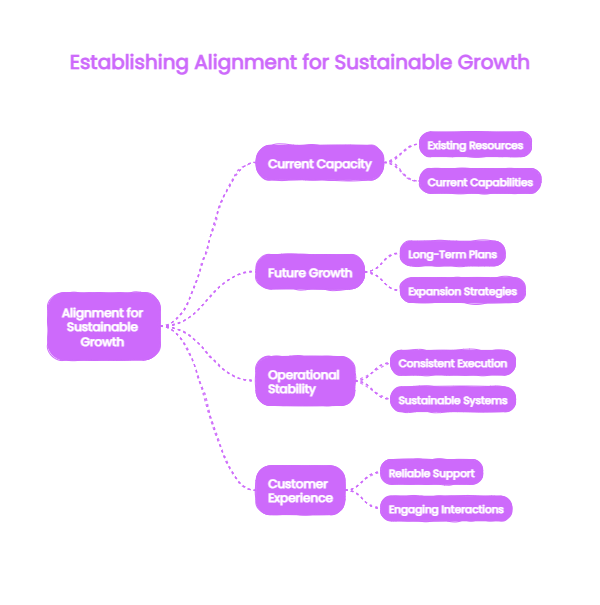
Alignment must be established within the realities of current capacity before future growth is considered. Funnel design should emerge from existing resources rather than projected assumptions. Operational readiness should determine structural complexity rather than aspiration alone. Systems should be built around what can be executed consistently and sustainably. Customer experience should reflect what the business can reliably support today. Growth can then occur from a stable operational foundation rather than an imagined one. Structure should support expansion without requiring it for survival.
This approach does not limit growth or ambition within the business. Instead, it creates conditions where growth can be sustained more effectively. Operational stability becomes the foundation upon which future complexity can be added intentionally. Resources are used more efficiently because the system remains aligned with reality. Teams gain confidence because execution becomes manageable and consistent. Customers receive a more reliable experience across every stage of engagement. Alignment strengthens both performance and sustainability simultaneously.
Working With the Funnel
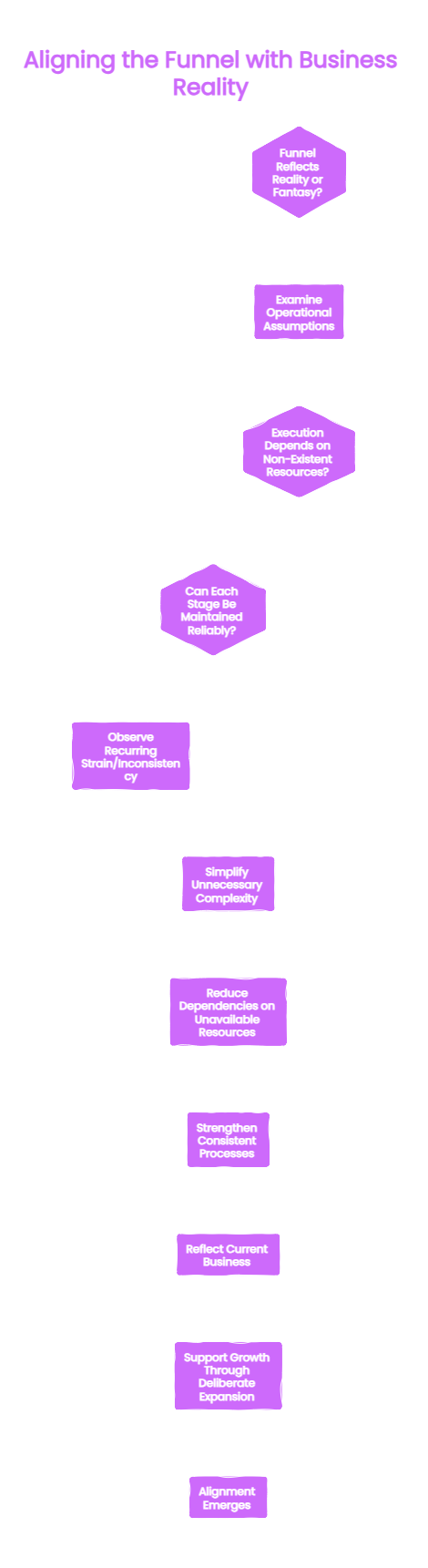
Working with this distortion begins by evaluating whether the funnel reflects current reality or future fantasy. Examine the operational assumptions embedded throughout the system carefully. Identify where execution depends upon resources, teams, or processes that do not yet exist consistently. Consider whether each stage can be maintained reliably within current capacity. Observe where recurring strain, inconsistency, or unfinished implementation continues appearing. These points often reveal where the funnel has been designed beyond operational reality. The goal is to understand where aspiration has exceeded support.
Once these areas become visible, simplification can begin intentionally. Remove unnecessary complexity that creates strain without providing meaningful clarity. Reduce dependencies that require resources not currently available. Strengthen processes that can be executed consistently and sustainably. Allow the funnel to reflect the business that exists today rather than the one imagined tomorrow. Growth can then be supported through deliberate expansion rather than assumed from the beginning. Alignment emerges when execution and experience operate within the same reality.
In Closing
Funnels should support the business that exists today while creating room for the business that may exist tomorrow. Sustainable growth emerges from systems grounded in operational reality rather than future assumptions. Complexity becomes valuable only when the capacity exists to support it consistently. When funnels are built beyond current readiness, strain becomes unavoidable. Execution weakens because the structure requires more than the business can provide reliably. The issue is not ambition but designing systems around conditions that have not yet been established. Misalignment turns growth plans into operational burdens.
When alignment exists, the funnel becomes easier to sustain and easier to trust. Execution strengthens because expectations match available resources and capabilities. Customer experiences become more consistent because the system operates within its actual capacity. Strategic growth becomes more achievable because it is built upon stability rather than assumption. The business gains clarity regarding what it can support today and what it can build tomorrow. Expansion becomes intentional rather than required for survival. Funnels perform best when they are designed for reality while creating space for growth.