
When Scaling Is Premature (And How Funnels Expose It)
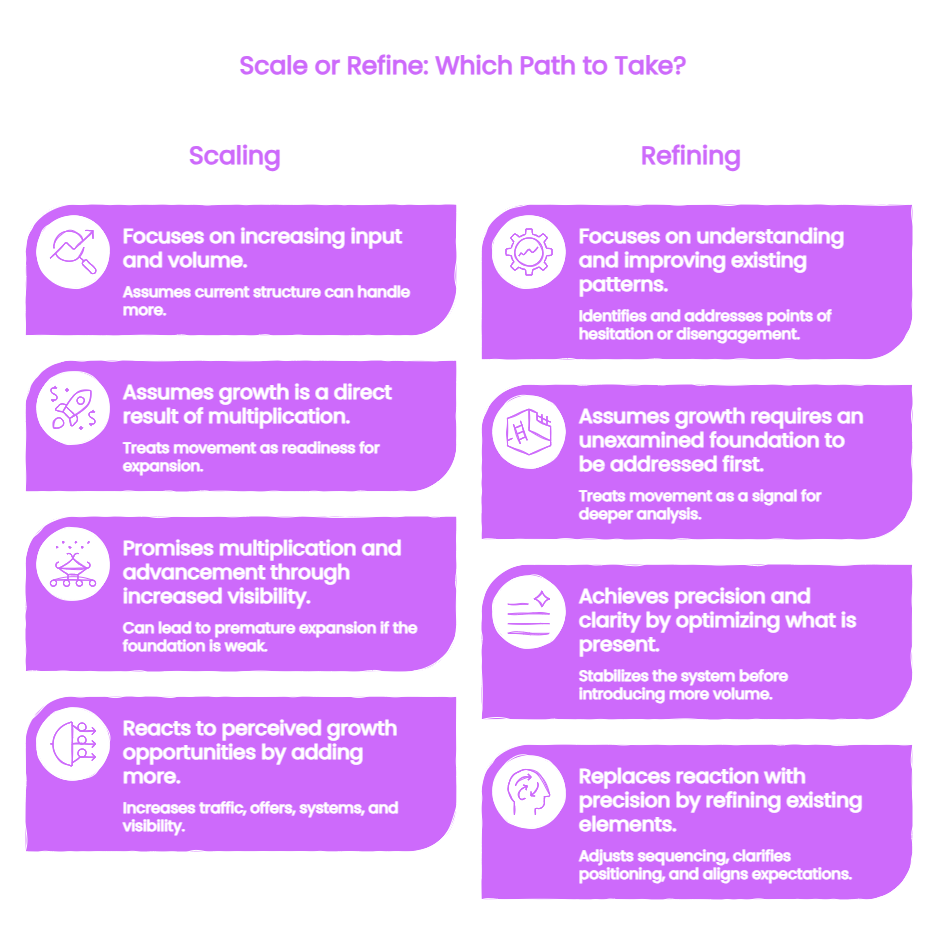
Growth is often treated as the natural next step once a business begins to see movement. Revenue starts to come in, interest increases, and there is a sense that expansion is the logical progression. More traffic, more offers, more systems, more visibility. Scaling feels like advancement because it promises multiplication. It suggests that what is working can simply be increased. This assumption holds weight because growth is commonly associated with success. But movement does not always mean readiness for expansion. In many cases, what appears to be a growth opportunity is actually an unexamined foundation.
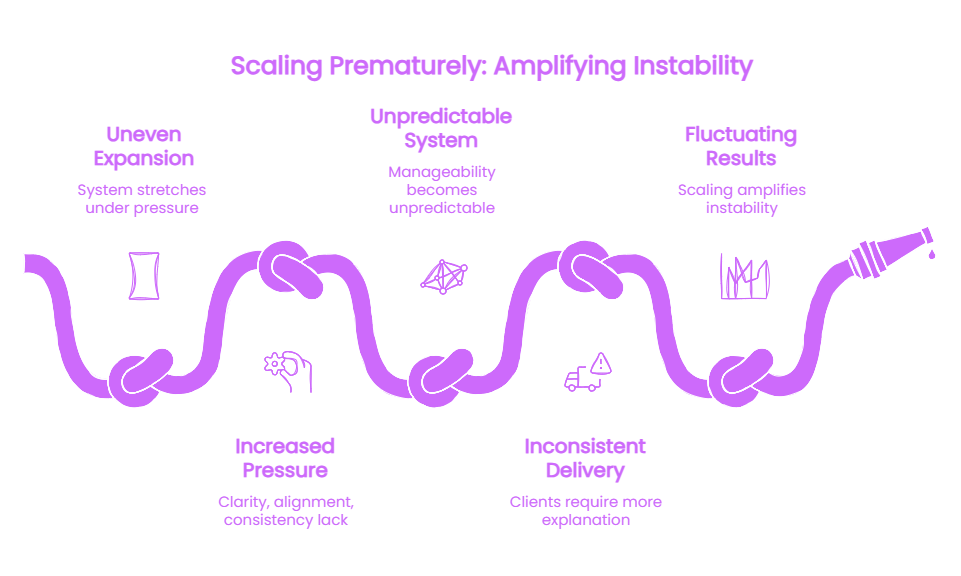
When scaling begins before structure is stable, the system does not expand evenly. It stretches. Pressure increases at every point where clarity, alignment, or consistency has not yet been secured. What once felt manageable begins to feel unpredictable. Clients require more explanation, delivery becomes inconsistent, and results fluctuate. This is not because scaling is inherently difficult, but because the system it is being applied to has not been fully formed. Scaling does not correct instability, it amplifies it.
What Scaling Actually Requires
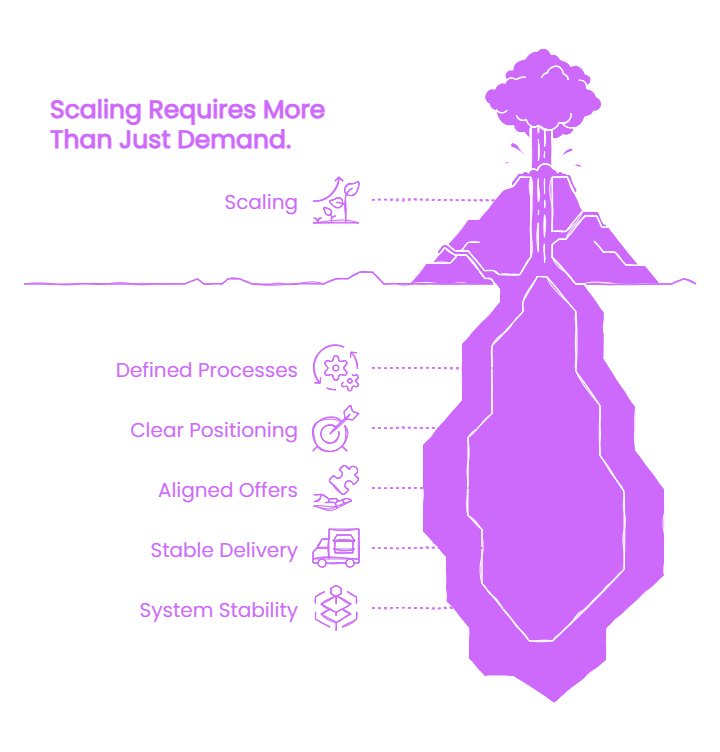
Scaling requires more than demand. It requires a system that can hold increased volume without losing clarity, consistency, or integrity. This includes defined processes, clear positioning, aligned offers, and stable delivery. Each of these elements must function without constant manual correction. If the business relies on improvisation to maintain results, scaling introduces more variables than the system can manage. What worked at a smaller level begins to break under pressure. This is not a failure of effort. It is a mismatch between expansion and capacity.
A system that is ready to scale does not depend on explanation to operate. It does not rely on constant adjustment to produce results. It has already resolved the core questions of who it serves, what it provides, and how it delivers value. Scaling, in this context, is not about doing more. It is about allowing what is already stable to reach more people. Without this stability, scaling becomes an attempt to grow something that has not yet been fully defined. And what is undefined cannot expand without distortion.
How Funnels Expose Readiness for Scale
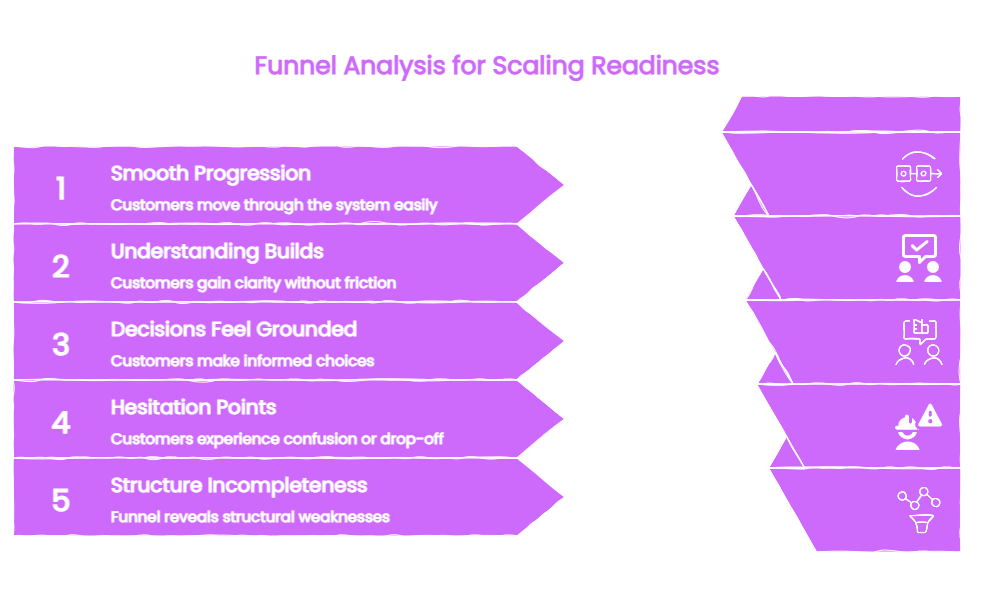
Funnels reveal whether a business is structurally prepared for expansion. They do this by showing how people move through the system when they encounter it. If progression is smooth, if understanding builds without friction, and if decisions feel grounded, the system is holding. If there are repeated points of hesitation, confusion, or drop off, the funnel is showing where structure is incomplete. These signals are not obstacles. They are indicators of readiness.
As volume increases, these signals become more pronounced. A small misalignment that was manageable at low traffic becomes a significant disruption at higher volume. Questions that were answered manually become bottlenecks. Unclear positioning leads to inconsistent expectations. The funnel does not create these issues. It reveals them. It shows how the system behaves under pressure. When read correctly, it becomes clear whether the business is ready to expand or whether it needs further refinement before doing so.
Where Premature Scaling Shows Up
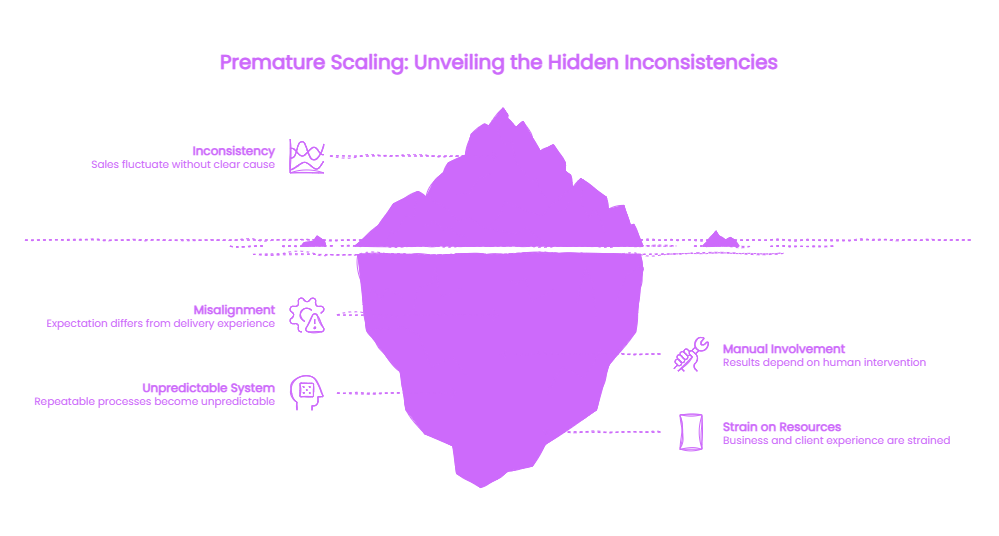
Premature scaling often appears as inconsistency. Sales fluctuate without clear cause. Some clients move forward easily while others require extensive clarification. Delivery feels uneven, and results vary depending on how much manual involvement is required. This creates a system that cannot sustain growth because it depends on constant intervention. What should be repeatable becomes unpredictable. The more volume increases, the more visible this inconsistency becomes.
It also appears in misalignment between expectation and experience. Clients enter with one understanding and encounter something different in delivery. This creates friction, not because the work lacks value, but because the structure did not establish clear alignment beforehand. Scaling increases the number of these interactions. Without correction, this leads to strain on both the business and the client experience. The system begins to feel heavy because it is carrying unresolved structure at a larger scale.
The Cost of Scaling Too Soon
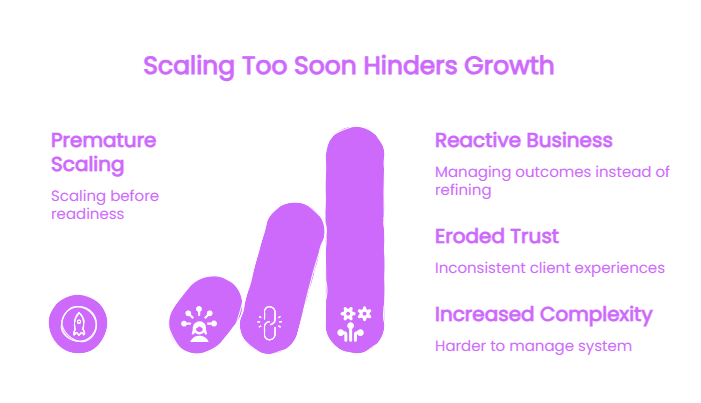
Scaling before readiness creates a cycle of correction. More traffic leads to more confusion, which leads to more explanation, which leads to more adjustment. The business becomes reactive rather than stable. Time is spent managing outcomes instead of refining the system that produces them. This slows growth rather than supporting it. What was intended to create efficiency instead creates complexity.
There is also a cost in trust. When experiences are inconsistent, clients cannot rely on the system to deliver predictably. This affects perception, referrals, and long-term stability. Scaling amplifies not only what works, but also what is unresolved. Without structural clarity, growth introduces strain rather than strength. The system becomes harder to manage, not easier to expand.
Strengthening Before Expanding
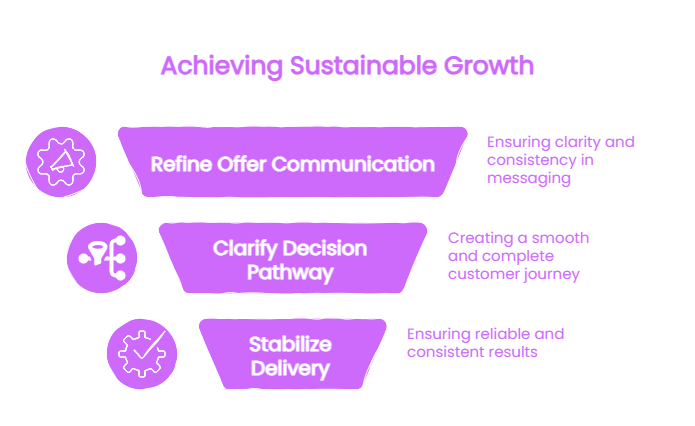
Before increasing volume, the system must be able to hold what it already has. This means refining how the offer is communicated so it is consistently understood. It means ensuring that the pathway from entry to decision is clear and complete. It means stabilizing delivery, so results do not depend on constant adjustment. These are not separate from growth. They are what make growth sustainable.
This work is not visible in the same way scaling is. It does not create immediate increases in numbers. But it creates stability that allows those numbers to hold when they do increase. When clarity, alignment, and consistency are established, scaling becomes a natural extension of what is already working. Without this, it becomes an attempt to expand something that is still forming.
Working With What the Funnel Shows You
The funnel provides direct information about where the system is holding and where it is not. Where people move forward easily, structure is supporting them. Where they hesitate or disengage, something requires attention. Instead of increasing input, the focus shifts to understanding these patterns. What is being asked at that point? What has or has not been established before it? What assumption is being made that has not been confirmed?
This approach replaces reaction with precision. Rather than adding more traffic or more elements, you refine what is already present. You adjust sequencing so information arrives when it can be received. You clarify positioning so expectations align earlier. You allow the system to stabilize before introducing more volume. This is how funnels are used as instruments of clarity rather than tools of pressure.
In Closing
Scaling is not the next step simply because movement exists. It is the next step when the system can hold expansion without losing coherence. Funnels make this visible. They show whether the business is ready for growth or still forming the structure required to support it. When read accurately, they remove guesswork and replace it with clarity.
Growth that is built on stable structure does not require constant correction. It expands naturally because the system it is built on is clear, aligned, and consistent. When that foundation is in place, scaling does not create strain. It reveals strength.