
When Decision Ownership is Avoided in Funnel Builds
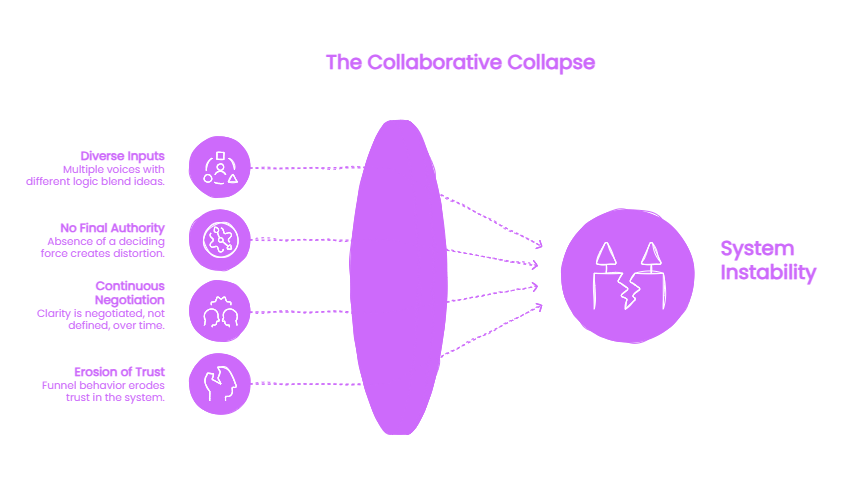
When a funnel is being built with multiple inputs but no single line of direction, it often looks collaborative on the surface yet feels increasingly unstable underneath. Ideas come from different voices, each with their own logic, urgency, or preference, and everything begins to blend rather than resolve. Nothing is inherently wrong with contribution, but the absence of a final deciding force creates quiet distortion in how the funnel takes shape. Decisions are suggested, resuggested, adjusted, and revisited without ever fully landing into a settled structure. What should feel like forward movement starts to feel like looping refinement without arrival. The funnel begins to reflect the emotional and operational state behind it rather than a clear strategic intention.
When there is no ownership of final direction, even strong ideas lose their coherence in the process. This is where many systems quietly break without obvious failure points to point to. It does not collapse because people are not smart or because input is lacking. It weakens because no one is holding the responsibility of final coherence. Collaboration is not the issue here, but diffusion of authority is. When everything requires consensus or continuous validation from multiple directions, clarity becomes something that is constantly negotiated instead of defined. Over time, the funnel stops behaving like a structured path and starts behaving like an ongoing conversation with no conclusion. The result is not just inefficiency, but a subtle erosion of trust in the system itself.
What Avoided Decision Ownership Actually Is
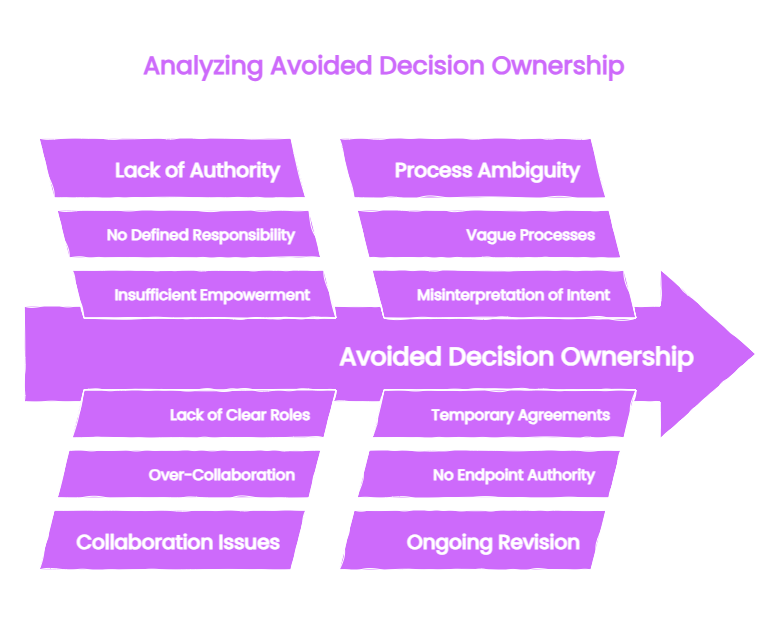
Avoided decision ownership is not simply indecision, nor is it collaboration taken too far. It is the absence of a clearly defined authority responsible for making final calls that preserve coherence. In these environments, decisions are never fully closed because no one has been positioned or empowered to close them. Input may be gathered extensively, but the transition from input to conclusion remains incomplete. This creates a structure where ideas can exist but cannot fully settle into form. Responsibility becomes distributed in a way that feels inclusive, yet removes the stabilizing force required for clarity. Without ownership, every decision remains temporarily open, even when it appears to be resolved on paper.
What makes this particularly disruptive is that it often hides behind process language or collaborative intent. On the surface, it may look like shared alignment or careful consideration. In practice, it results in ambiguity about who is responsible for final direction. When something is unclear, it is adjusted. When it is adjusted, it is questioned again. This cycle continues not because refinement is bad, but because there is no endpoint authority. The funnel becomes a space of ongoing revision rather than committed structure. Over time, this creates a system where nothing is truly finalized, only temporarily agreed upon until the next round of input.
What It Looks Like in Practice
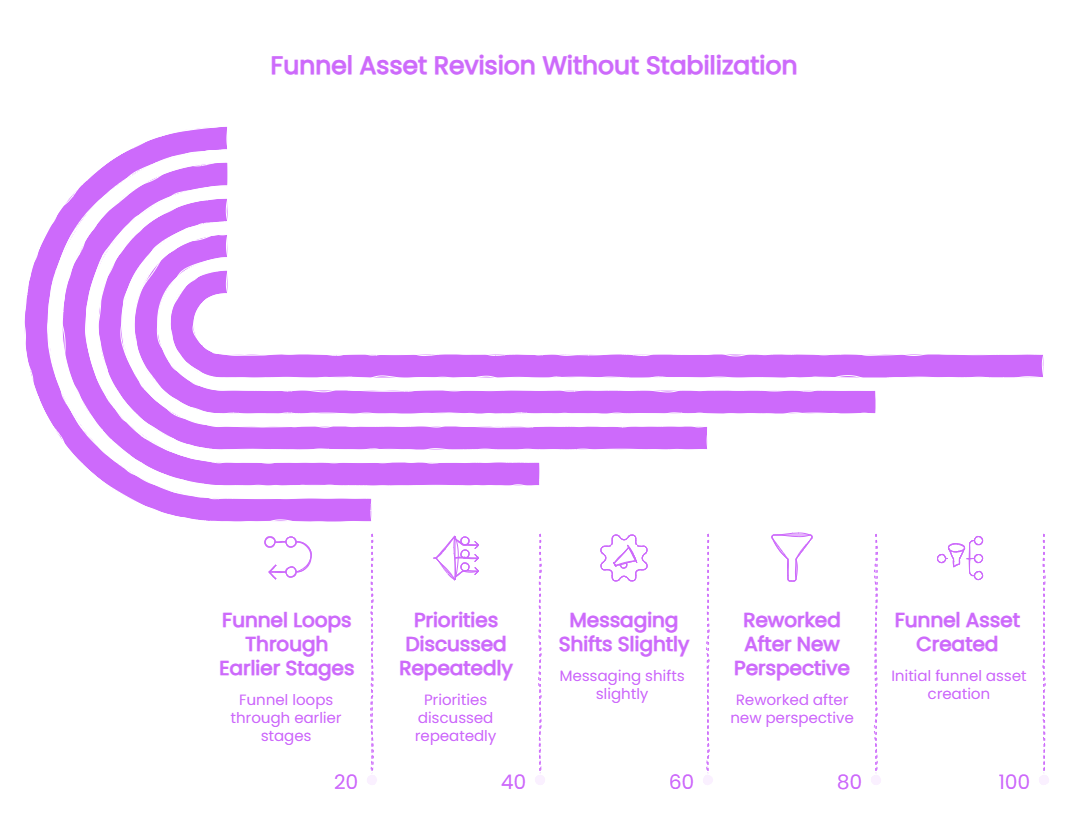
In practice, avoided decision ownership shows up as constant revision without stabilization. A funnel asset is created, then reworked after every new perspective is introduced. Messaging shifts slightly depending on who last weighed in, creating subtle inconsistencies that accumulate over time. Priorities are discussed repeatedly but rarely locked, which leads to shifting focus even within a single build cycle. Teams or contributors may feel active, but the work itself lacks directional anchoring. Instead of moving from stage to stage with clarity, the funnel loops through earlier stages in response to new opinions. The structure begins to reflect hesitation rather than intention.
Another common expression is hesitation around committing to a final version of anything. Even when something is “approved,” it often carries an unspoken openness for further adjustment. This creates a sense that nothing is ever fully complete, only provisionally accepted. People begin to adjust their output preemptively, trying to anticipate future objections rather than working from a stable brief. This leads to diluted messaging, overextended explanations, and fragmented user experience. The funnel stops feeling like a guided path and starts feeling like a negotiation between competing interpretations. Over time, clarity is replaced by cautious adaptability, which weakens conversion and coherence.
How Funnels Reveal This Distortion
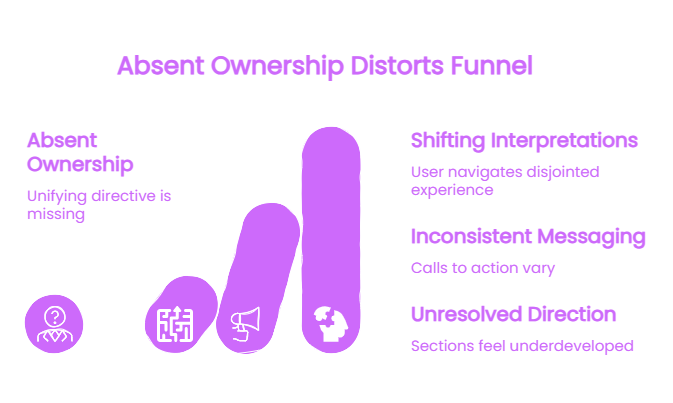
Funnels are particularly sensitive to decision ownership because they rely on sequence, clarity, and progression. When ownership is absent, each stage begins to reflect different assumptions about what the funnel is meant to do. One stage may prioritize education, another persuasion, and another qualification without a unifying directive. This creates breaks in continuity where the user experience feels disjointed rather than guided. Instead of moving through a coherent narrative, the user moves through shifting interpretations of intent. The funnel still functions structurally, but not meaningfully.
This distortion becomes visible through inconsistent messaging and uneven transitions between stages. Calls to action may vary in tone or urgency depending on who influenced that segment most recently. Some sections may feel overly detailed while others feel underdeveloped, not because of strategy but because of unresolved direction. The user is left to do the work of interpretation that the funnel was meant to carry. This creates friction where there should be flow. Over time, the funnel stops behaving like a single system and starts behaving like a collection of partially aligned ideas that never fully consolidated into one path.
Why More Input Doesn’t Fix It
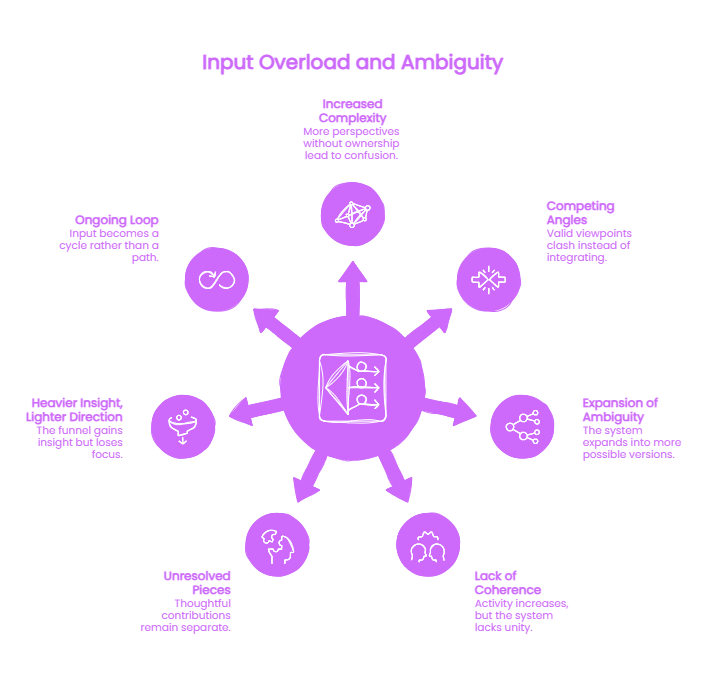
A common misunderstanding in these situations is that more input will eventually create clarity. In reality, additional perspectives without ownership tend to increase complexity rather than resolve it. Each new voice introduces another valid angle, but without a final authority, those angles compete instead of integrate. The result is not refinement but expansion of ambiguity. Instead of narrowing toward a decision, the system expands into more possible versions of itself. This can feel productive because activity increases, but coherence does not.
Clarity does not emerge from accumulation of opinion, but from the presence of a deciding force. Without that, even the most thoughtful contributions remain unresolved pieces rather than integrated structure. The funnel becomes heavier with insight but lighter on direction. Teams may feel like they are getting closer because more is being discussed, but the center of decision remains unmoved. At some point, the system must transition from gathering perspective to establishing direction. Without that transition, input becomes an ongoing loop rather than a path toward resolution.
Where Ownership Must Be Established
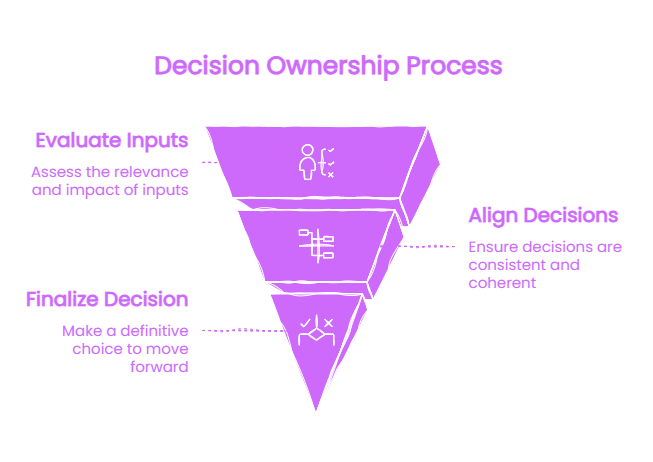
Ownership must be clearly placed at the point where decisions affect coherence, not just execution. This is the role that determines whether the funnel holds together as one unified experience. It does not mean removing collaboration, but defining who carries the responsibility of final alignment. That role ensures that inputs are evaluated, not endlessly negotiated. Without this clarity, even well-structured funnels begin to drift under the weight of competing interpretations. Ownership stabilizes the system by giving it a center of gravity.
This does not require authoritarian control, but it does require final responsibility. Someone must be accountable for saying when enough input has been integrated and a decision has been made. That moment is what allows the funnel to move forward instead of circling back. When ownership is present, feedback becomes refinement rather than redefinition. The structure gains consistency because it is anchored in a singular line of direction. This is what allows complexity to exist without turning into confusion.
Working With the Funnel
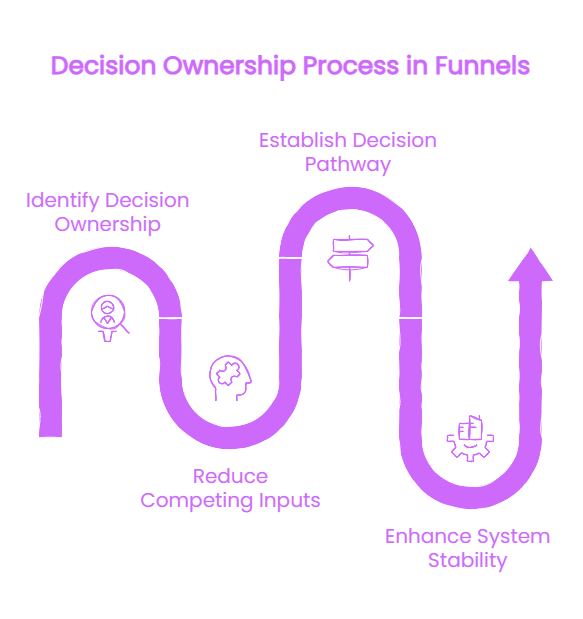
To work with this distortion, the first step is identifying where decision ownership currently sits, if it exists at all. Many funnels operate under the assumption that ownership is shared when in reality it is undefined. Clarifying this removes hidden ambiguity that often drives inconsistency. Once identified, the next step is reducing competing inputs at the decision level, not eliminating collaboration but sequencing it properly. Input should inform, not continuously reopen finalized decisions. This shift alone begins to restore structural stability.
From there, establish a clear decision pathway where one role holds responsibility for final coherence across funnel stages. This allows others to contribute without needing to resolve alignment themselves. The funnel becomes easier to maintain because direction is no longer constantly renegotiated. Each stage can then operate with confidence in the structure it is supporting. Over time, this creates a system that is not only clearer but more efficient and more trustworthy in its progression. The goal is not less input, but more defined direction.
In Closing
Clarity in funnel systems does not come from the volume of ideas but from the presence of ownership that can resolve them into form. Without that, even strong strategy becomes unstable under the weight of unresolved direction. What looks like collaboration can quietly become diffusion, and what feels like refinement can become repetition. Funnels require a point of decision that holds coherence when inputs diverge. Without that point, the system reflects hesitation rather than intention. And hesitation, when embedded into structure, eventually becomes the experience of the user moving through it.
To build funnels that hold, decision ownership cannot be optional or implied. It must be explicit, active, and accountable. Only then can input serve its purpose without destabilizing the structure it is meant to strengthen. When ownership is present, clarity becomes repeatable rather than accidental. The funnel stops reacting and starts progressing. And in that shift, alignment becomes something the system produces consistently, not something it hopes to arrive at.