
What Your Funnel Reveals About Client Readiness
Funnels are often evaluated only by their conversion rate, but they reveal far more than whether a purchase occurs. A funnel functions as a structured decision pathway, and the way people move through that pathway reveals how ready they are to make the decision being offered. When conversions are low, the immediate assumption is often that something in the funnel itself is broken. Businesses may revise copy, redesign pages, or change tools in an attempt to correct the issue. Yet in many situations, the funnel is not malfunctioning at all. Instead, it is accurately reflecting the readiness level of the audience encountering it. Funnels do not create readiness, they only channel the readiness that already exists within the market. Learning to interpret funnel performance in this way transforms it from a source of frustration into a source of insight.
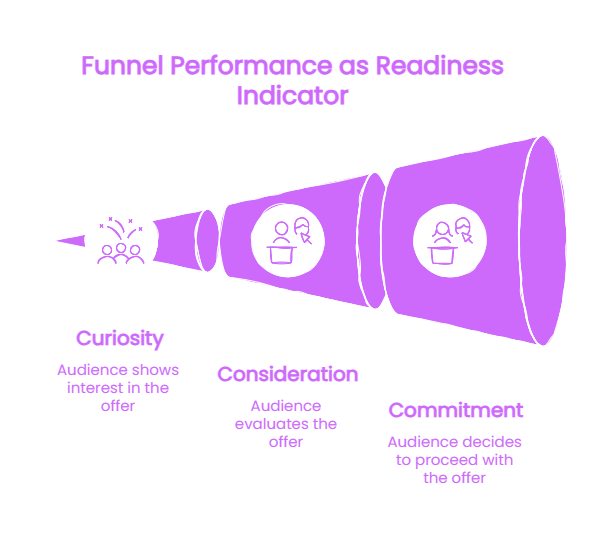
When an audience is prepared for the decision an offer requires, their behavior inside the funnel tends to be clear and decisive. Engagement flows naturally from curiosity into consideration and ultimately into commitment. When readiness is lower, the same funnel may reveal hesitation, delays, or incomplete actions. These patterns are not random occurrences but signals about the audience's relationship to the problem and the proposed solution. Businesses sometimes attempt to solve these signals through increased persuasion or heavier promotion. However, persuasion cannot replace readiness that has not yet developed. Understanding this distinction allows businesses to evaluate their funnels more realistically. Instead of assuming failure, they can begin to read the structural feedback the funnel is providing.
Structural Signals of Readiness
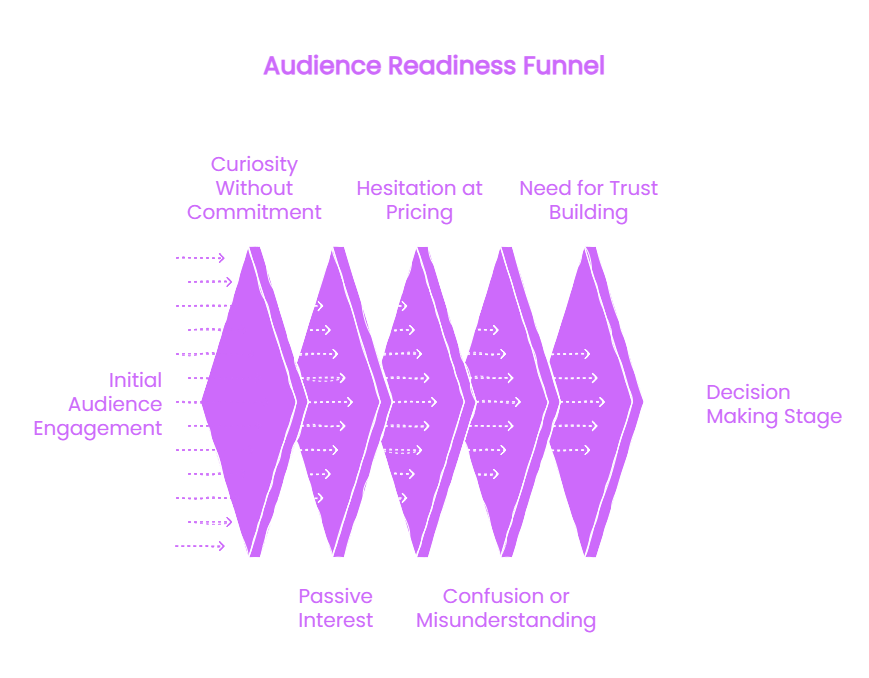
Funnels provide measurable indicators that help reveal how prepared an audience is to move forward. For example, high click through rates combined with low purchase rates often indicate curiosity without commitment. Visitors may find the topic interesting but remain uncertain about investing in the solution. Similarly, a webinar funnel that attracts large registration numbers but low attendance may reveal passive interest rather than active engagement. These patterns suggest that the audience is willing to explore the idea but has not yet reached a decision making stage. In this way, the funnel becomes a diagnostic tool rather than merely a marketing mechanism. The behavior inside the funnel reflects how people perceive the value and urgency of the offer. Businesses that learn to recognize these patterns gain valuable insight into their market.
Drop off points also reveal where readiness begins to weaken. When prospects disengage immediately after learning about pricing, the issue may involve perceived value or investment readiness. If the drop off occurs earlier in the process, it may indicate confusion or incomplete understanding of the offer. Some audiences consume educational material but hesitate when asked to make a commitment. This often signals that additional context or trust building is needed before the decision stage. Businesses sometimes misinterpret these patterns as technical problems or copywriting failures. In reality, they may reflect the natural progression of audience awareness and confidence. Recognizing these signals allows the funnel to function as a map of audience readiness rather than simply a measurement of sales.
When a Funnel Exposes Misalignment
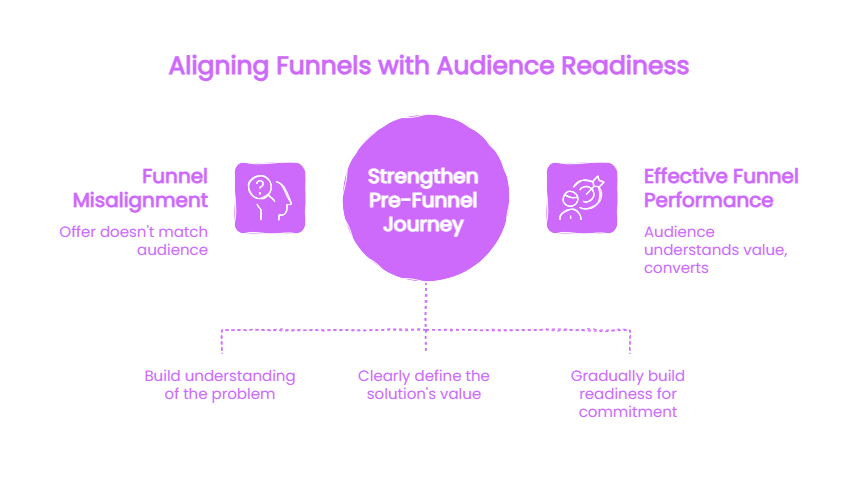
A funnel is designed with a particular level of decision in mind. Some funnels invite a small step, such as joining an email list or downloading a guide. Others invite a larger commitment, such as purchasing a program or investing in a service. When the decision requested by the funnel does not match the readiness of the audience, misalignment becomes visible. The structure may be sound, yet the audience may not be prepared to move forward in the way the funnel expects. This situation is common when advanced funnels are presented to audiences that are still learning about the problem being addressed. Rather than guiding them toward clarity, the funnel can feel abrupt or overwhelming. The resulting hesitation is often interpreted as poor funnel performance. However, the real issue may lie in the relationship between the offer and the audience's level of understanding.
High ticket funnels often make this misalignment particularly visible. Because the financial and psychological commitment is greater, prospects require deeper clarity and confidence before deciding. If that foundation has not yet been established, even a well-designed funnel may struggle to convert. Businesses sometimes attempt to resolve this by adding more persuasive language or urgency. While these tactics can increase engagement temporarily, they rarely resolve the underlying misalignment. The more effective approach is to strengthen the journey leading into the funnel itself. Educational content, positioning, and audience preparation can gradually build the readiness required. When the audience arrives already understanding the value of the solution, the funnel functions much more effectively.
Structural Application
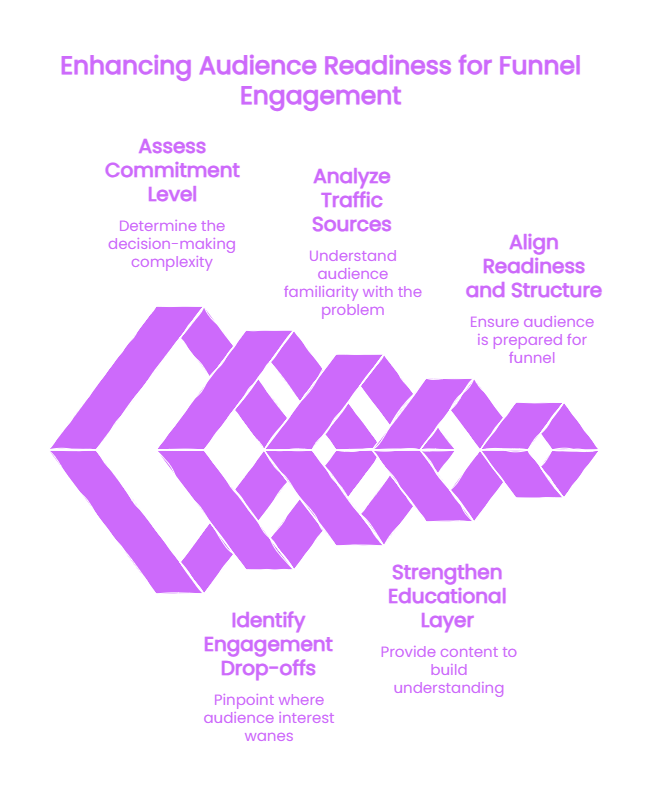
Interpreting funnel performance begins with understanding the level of commitment the funnel requires. Some funnels request minimal decisions, while others invite significant financial or strategic investment. Businesses benefit from asking whether their audience is accustomed to making decisions at that level. If not, the funnel may be revealing a readiness gap rather than a structural flaw. Examining where engagement drops off can provide additional clues about this gap. Patterns across different traffic sources may also highlight differences in audience maturity. Some audiences arrive already familiar with the problem, while others encounter it for the first time. Recognizing these distinctions allows businesses to adapt their approach more thoughtfully. Instead of rebuilding funnels repeatedly, they can refine how the audience is prepared to enter them.
This preparation may involve strengthening the educational layer that precedes the funnel. Articles, case studies, and other forms of content can help prospects understand both the problem and the potential solution. As clarity grows, confidence in the decision also increases. Over time, the audience becomes more capable of responding to the funnel in the way it was originally designed. The structure remains the same, but the context surrounding it becomes stronger. When readiness and structure begin to align, conversion improves naturally. The funnel no longer feels like a barrier but like a pathway that makes sense to the audience. This alignment is often the difference between a funnel that struggles and one that performs consistently.
Closing
Funnels are frequently judged by a single outcome, whether a sale occurs. Yet they offer a deeper layer of information about the relationship between a business and its audience. Every interaction inside the funnel reflects how people perceive the offer and how prepared they are to act on it. When businesses view funnels through this lens, performance data becomes far more meaningful. Instead of searching endlessly for technical fixes, they can focus on understanding the audience itself. This perspective allows marketing decisions to be guided by insight rather than assumption. Over time, the funnel becomes not just a selling tool but a learning structure. It reveals where clarity exists and where preparation is still needed.
Each funnel tells a story about the audience interacting with it. The pacing of decisions, the moments of hesitation, and the points of commitment all contribute to that story. When businesses learn to read these patterns carefully, their strategy becomes more precise. They begin to recognize when readiness is present and when further development is necessary. This awareness prevents unnecessary rebuilding and experimentation. Instead, energy can be directed toward strengthening the relationship between the audience and the offer. In that environment, funnels perform the role they were designed to fulfill. They guide prepared prospects toward decisions that already make sense to them.