What Luxury Requires Operationally; Not Visually
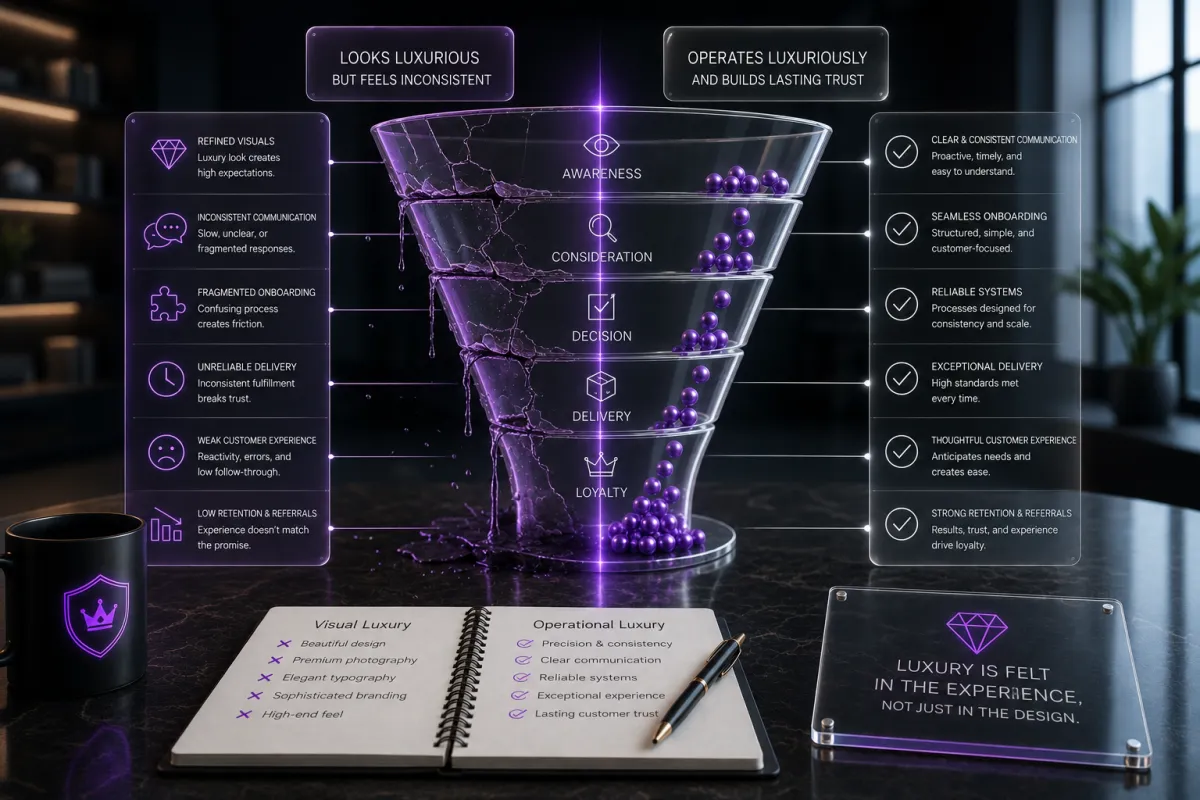
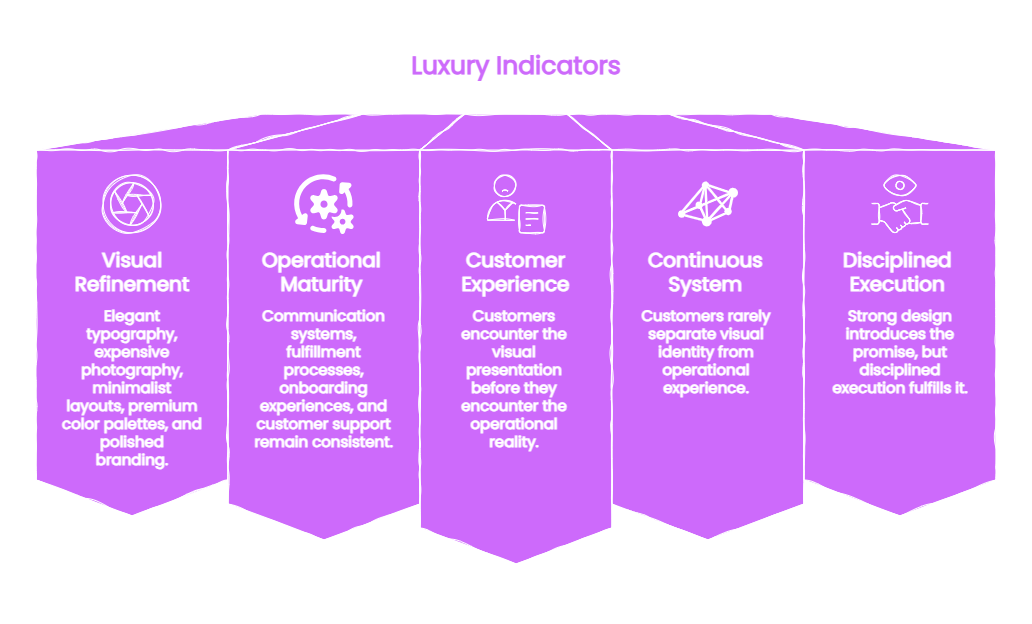
Businesses frequently attempt to create luxury through visual refinement alone. Elegant typography, expensive photography, minimalist layouts, premium color palettes, and polished branding often become the primary indicators of luxury within a funnel. These visual choices certainly influence first impressions and can elevate perceived quality. However, they cannot independently establish a luxurious customer experience. Customers encounter the visual presentation before they encounter the operational reality behind it. The appearance may communicate sophistication immediately, but operations ultimately determine whether that impression remains credible. Luxury therefore begins long before the customer notices the design itself.
Many businesses unintentionally confuse aesthetic refinement with operational maturity. They invest heavily in logos, websites, brand photography, and visual consistency while communication systems, fulfillment processes, onboarding experiences, and customer support remain inconsistent. The result is a funnel that looks exceptional during discovery but becomes increasingly unstable after engagement begins. Every interaction either strengthens or weakens the expectation established by the presentation. Customers rarely separate visual identity from operational experience because they perceive the business as one continuous system. Luxury is therefore experienced operationally before it is remembered visually. Strong design introduces the promise, but disciplined execution fulfills it.
What Operational Luxury Actually Means
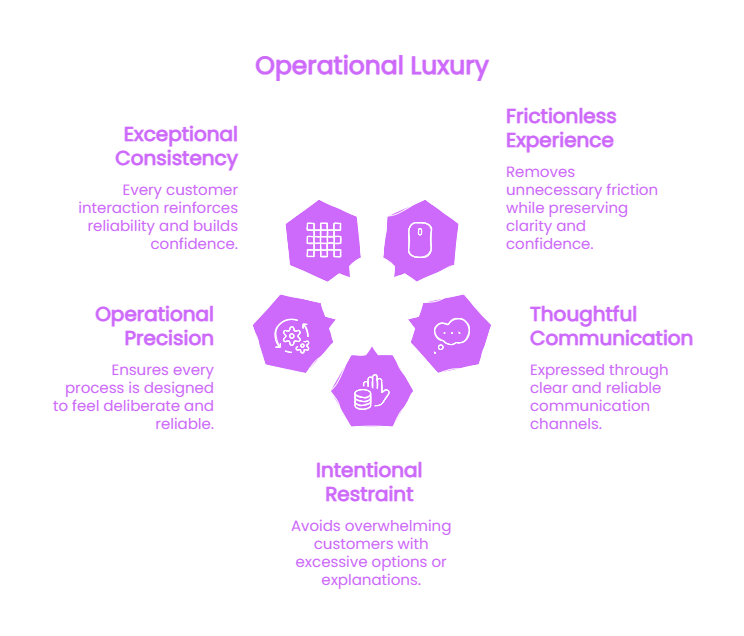
Operational luxury is the disciplined practice of creating an experience that consistently removes unnecessary friction while preserving clarity, confidence, and continuity. It is expressed through thoughtful communication, reliable execution, intentional restraint, operational precision, and exceptional consistency. Every process is designed to feel deliberate rather than reactive. Every customer interaction reflects preparation rather than improvisation. Expectations are communicated clearly before uncertainty has the opportunity to emerge. Decisions are made intentionally instead of emotionally. The result is an experience that feels effortless because significant operational discipline exists beneath the surface.
Luxury is often mistaken for abundance when it is more accurately defined by precision. A luxurious experience rarely overwhelms customers with excessive options, unnecessary explanations, or constant urgency. Instead, it simplifies decisions through carefully designed systems that eliminate avoidable complexity. Communication arrives when it is needed. Processes remain predictable without becoming mechanical. Customer confidence grows because every interaction reinforces reliability rather than requiring reassurance. Operational luxury is therefore measured less by what is added and more by what has been intentionally removed.
What It Looks Like in Practice
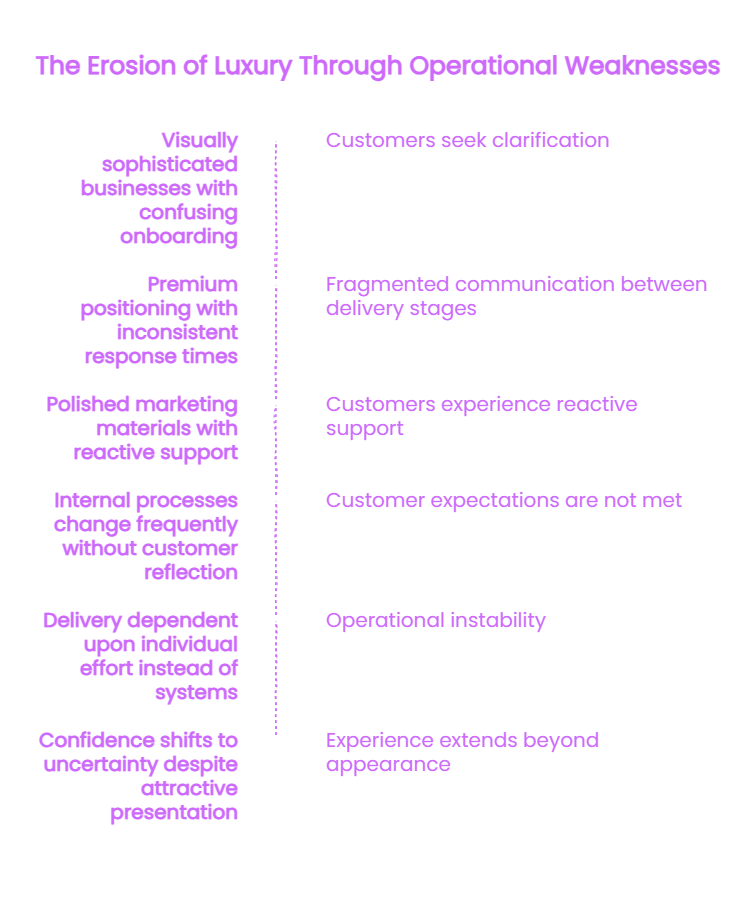
The absence of operational luxury often appears behind visually sophisticated businesses. A beautifully designed website leads to confusing onboarding instructions that require customers to seek clarification. Premium positioning is followed by inconsistent response times or fragmented communication between different stages of delivery. Customers receive polished marketing materials but experience reactive support whenever questions arise. Internal processes change frequently without being reflected in customer expectations. Delivery becomes dependent upon individual effort instead of repeatable operational systems. The experience gradually shifts from confidence to uncertainty despite maintaining an attractive visual presentation.
Customers rarely evaluate isolated interactions because they experience the business as a connected journey. A premium sales page cannot compensate for inconsistent fulfillment after purchase. Sophisticated branding cannot erase uncertainty created by unclear communication. Beautiful design cannot replace dependable systems when customer expectations require consistency. Every operational weakness gradually reduces confidence regardless of how refined the presentation appears. The contrast between appearance and execution becomes increasingly noticeable throughout the customer journey. Operational instability eventually overshadows visual sophistication because experience always extends beyond appearance.
How Funnels Reveal This Distortion
Funnels establish expectations before customers directly experience the business. Every page, email, form, confirmation message, scheduling process, and follow-up interaction communicates assumptions about the experience ahead. Luxury positioning naturally creates expectations of precision, consistency, thoughtful pacing, and operational excellence. Customers begin evaluating whether those expectations are being confirmed almost immediately after engagement begins. Each stage either reinforces confidence or introduces uncertainty. The funnel therefore becomes an operational demonstration rather than merely a marketing sequence. It reveals whether presentation accurately reflects reality.
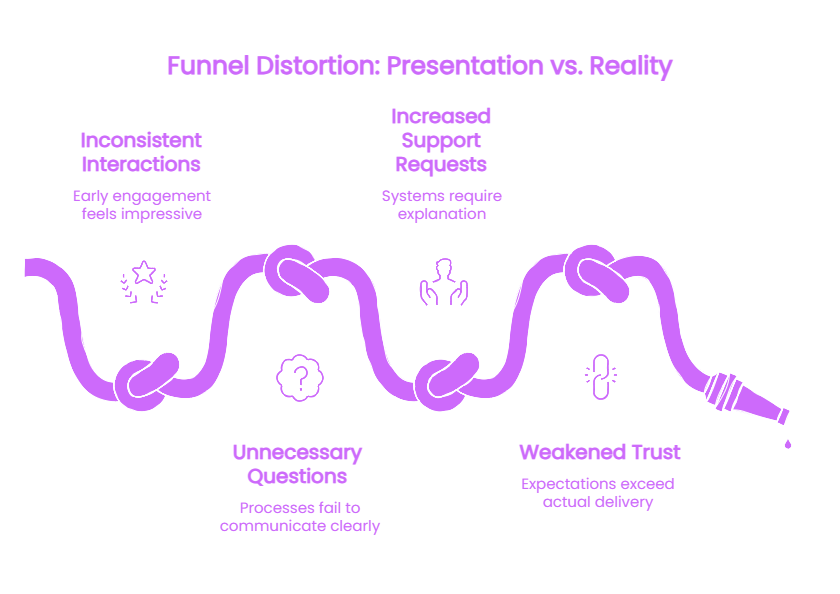
Distortion becomes visible whenever visual refinement exceeds operational maturity. Early engagement feels impressive while later interactions become increasingly inconsistent. Customers begin asking unnecessary questions because processes fail to communicate clearly. Support requests increase because systems require explanation instead of providing guidance naturally. Trust weakens when expectations repeatedly exceed actual delivery. The funnel exposes these gaps because every transition creates another opportunity for operational evidence. Luxury cannot remain convincing when operational consistency is repeatedly interrupted.
Why Better Design Doesn't Create Luxury
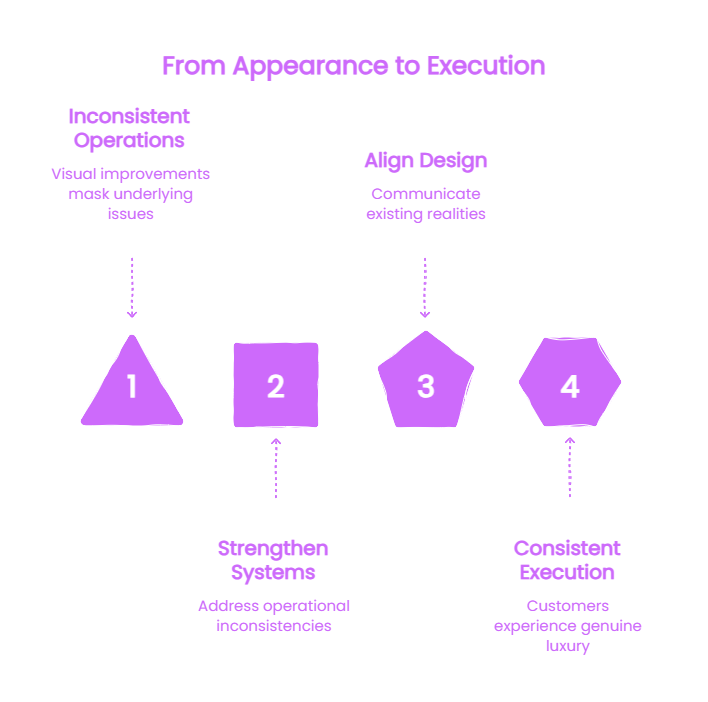
Businesses often respond to operational inconsistency by improving visual presentation instead of strengthening operational systems. They redesign websites, refine typography, update photography, modernize layouts, or invest in increasingly sophisticated branding. While these improvements may strengthen first impressions, they cannot resolve inconsistent execution. Better aesthetics simply increase the number of customers encountering the same operational limitations. Greater visual refinement amplifies expectations that unsupported systems struggle to fulfill. The gap between perception and experience becomes more noticeable rather than less. Design communicates possibility, but operations determine credibility.
Appearance serves an important purpose within positioning because it establishes expectation efficiently. However, expectation without operational support becomes increasingly fragile over time. Customers remember how consistently a business delivered more than how beautifully it introduced itself. Reliability produces confidence more effectively than visual sophistication alone. Operational discipline creates experiences that customers naturally describe as premium without requiring constant explanation. Design should therefore communicate realities that already exist rather than attempting to compensate for realities that do not. Luxury survives because execution consistently validates appearance.
Where Luxury Must Actually Be Built
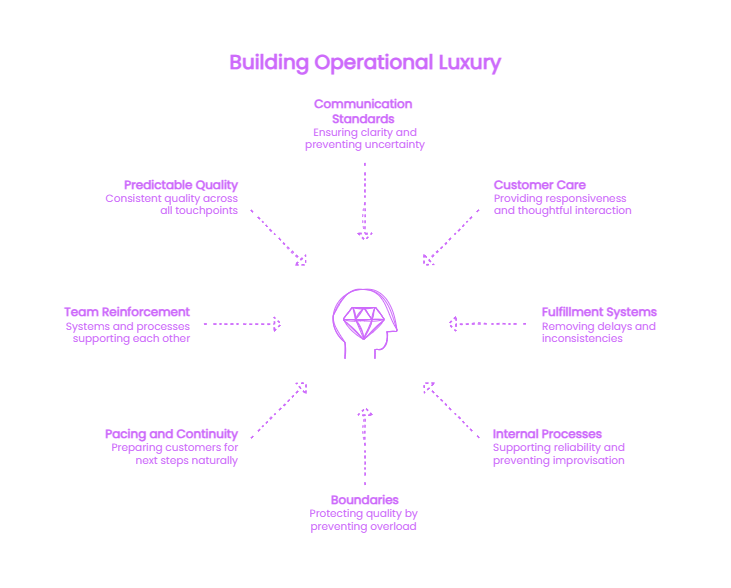
Luxury begins inside the operational decisions that customers rarely see directly but consistently experience. Communication standards establish clarity before uncertainty develops. Customer care creates confidence through responsiveness, preparation, and thoughtful interaction. Fulfillment systems remove unnecessary delays and inconsistencies before customers notice them. Internal processes support reliability instead of depending upon constant improvisation. Boundaries protect quality by preventing operational overload. Every disciplined decision strengthens the overall experience before visual branding communicates it.
Operational excellence also requires intentional pacing and thoughtful continuity across the entire customer journey. Each interaction should naturally prepare customers for what happens next without requiring unnecessary explanation. Teams, systems, and processes should reinforce one another instead of competing for attention. Customers should experience predictable quality regardless of which touchpoint they encounter. Luxury emerges because every operational element functions together as a coherent system. Visual identity becomes a reflection of disciplined execution rather than an attempt to conceal inconsistency. Sustainable positioning is always built from operational reality outward.
Working With the Funnel
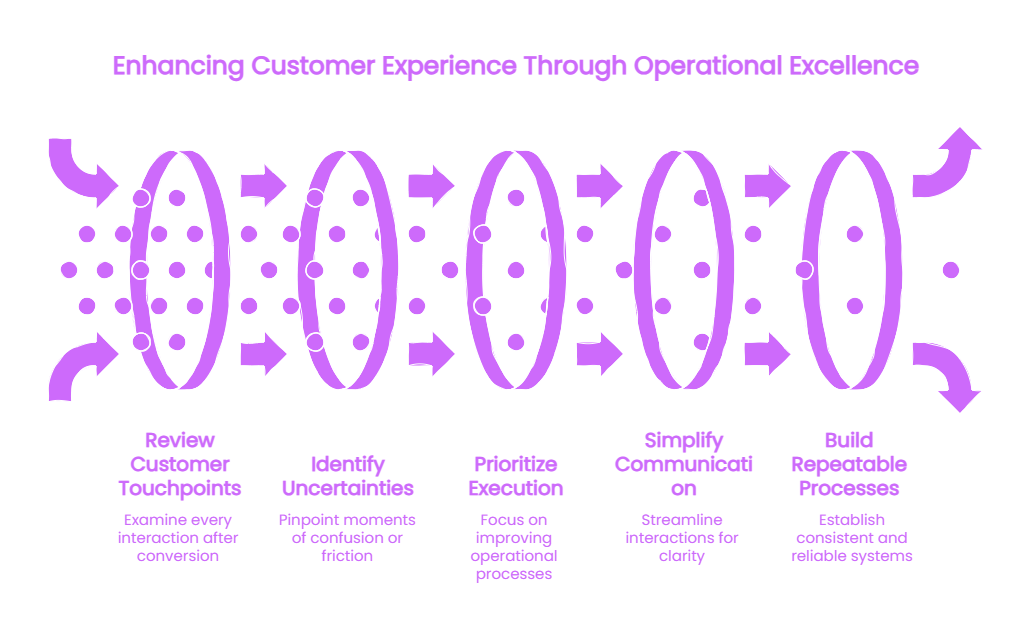
Review your funnel by examining every customer touchpoint after the initial conversion. Move through the experience exactly as a customer would from beginning to end. Compare the sophistication of the presentation against the consistency of the operational experience. Identify moments where customers may encounter uncertainty, unnecessary friction, delayed communication, inconsistent expectations, or fragmented processes. Observe whether each interaction reinforces the confidence established during the buying journey. Document where operational maturity falls behind visual refinement. Honest evaluation creates the foundation for meaningful improvement.
Prioritize strengthening execution before investing further in visual enhancements. Simplify communication wherever customers require unnecessary clarification. Build repeatable processes that consistently support reliability instead of depending upon individual effort. Remove avoidable friction through intentional operational design rather than additional explanations. Allow customer experience to become increasingly predictable without becoming impersonal. As operational consistency improves, visual branding naturally becomes more credible because it reflects an experience customers repeatedly confirm. The strongest funnels communicate operational truth through every interaction rather than through aesthetics alone.
In Closing
Customers experience luxury through disciplined operations long before they consciously recognize visual sophistication. Consistent communication, reliable execution, thoughtful pacing, intentional restraint, and operational precision create confidence that elegant branding alone cannot sustain. Every interaction either reinforces or weakens the expectations established by positioning. Businesses become genuinely luxurious when operational excellence consistently supports the promises introduced during discovery. Visual identity then serves as an accurate representation of lived customer experience rather than aspirational marketing. Luxury becomes believable because customers repeatedly encounter evidence supporting it. Operational discipline ultimately transforms positioning into trust.
The strongest funnels demonstrate that luxury is not created through decoration but through deliberate operational design. Beautiful presentation may attract attention, but operational consistency sustains confidence over time. Customers remember how a business made them feel throughout the experience rather than how attractive the first impression appeared. Every disciplined system contributes to an experience that feels calm, reliable, intentional, and trustworthy. Those qualities become the true indicators of luxury because they are repeatedly experienced instead of merely communicated. Funnels become genuinely luxurious when structure consistently eliminates unnecessary friction. Operational excellence is therefore the foundation upon which every credible luxury experience is built.