
What Is Mistaken for Warmth
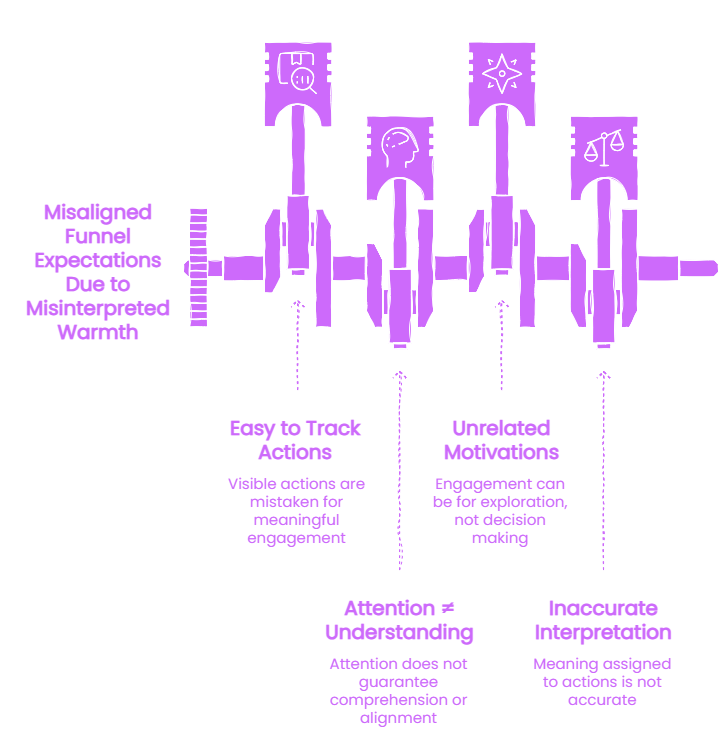
Many visible actions are mistaken for warmth because they are easy to track and quantify. Clicks, downloads, replies, and views create a sense of activity that appears meaningful on the surface. These signals are often interpreted as indicators of readiness because they show that attention has been given. However, attention does not equal understanding, and it does not confirm alignment. A person can engage with content for reasons that are unrelated to decision making. They may be exploring, comparing, or simply responding to curiosity.
When these actions are treated as proof of warmth, expectations become misaligned with reality. The funnel begins to operate under the assumption that the person is further along than they actually are. This creates a gap between what is being asked and what has been established. The result is hesitation, disengagement, or inaction that appears inconsistent with the level of engagement observed. The issue is not the behavior itself, but the meaning assigned to it. Without accurate interpretation, the funnel is built on assumptions rather than conditions.
How Funnels Interact with Lead Temperature
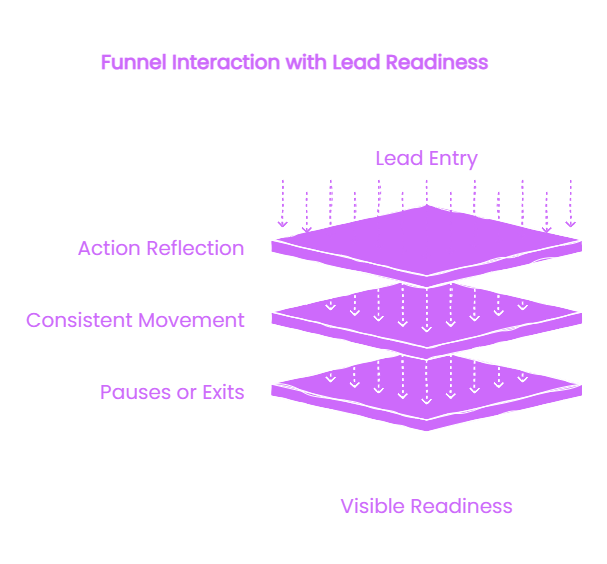
Funnels do not create warmth or readiness within a lead. They interact with what is already present and make it visible through behavior. As a person moves through a funnel, their actions reflect their level of clarity, trust, and alignment. If these conditions are established, movement appears consistent and steady. If they are not, the person pauses, revisits, or exits the sequence. The funnel does not influence these conditions directly. It reveals them at each stage of progression.
This is why funnels are often misunderstood when performance varies. The variation is not a sign that the funnel is inconsistent. It is a reflection of the different levels of readiness within the audience encountering it. Some individuals arrive prepared to move forward, while others are still forming understanding. The funnel does not standardize these differences. It makes them visible through patterns of behavior. When this is understood, the funnel becomes a source of information rather than a point of frustration.
What Happens When Warmth Is Assumed Too Early
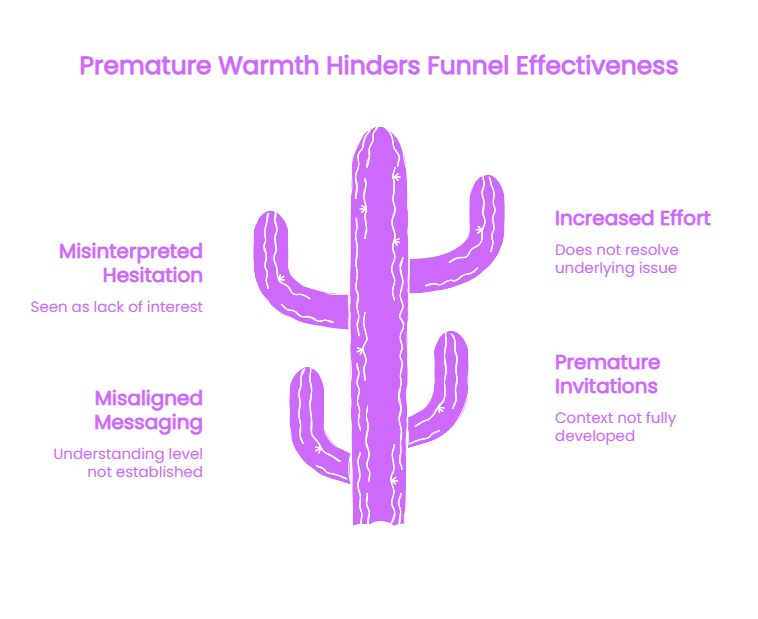
When warmth is assumed before it is present, the funnel begins to ask for decisions that the lead cannot yet support. Messaging becomes misaligned with the level of understanding that has actually been established. Invitations feel premature because the necessary context has not been fully developed. This creates hesitation that is often misinterpreted as lack of interest or poor performance. The response to this hesitation is usually to increase effort within the funnel itself.
Additional explanation is added, urgency is introduced, and more emphasis is placed on encouraging action. These adjustments increase the intensity of the interaction, but they do not resolve the underlying issue. The sequence remains unchanged, and the gap between readiness and expectation persists. The funnel becomes heavier without becoming more effective. The issue is not that the message lacks strength, but that the timing of the request does not match the state of the lead.
Working With Lead Readiness
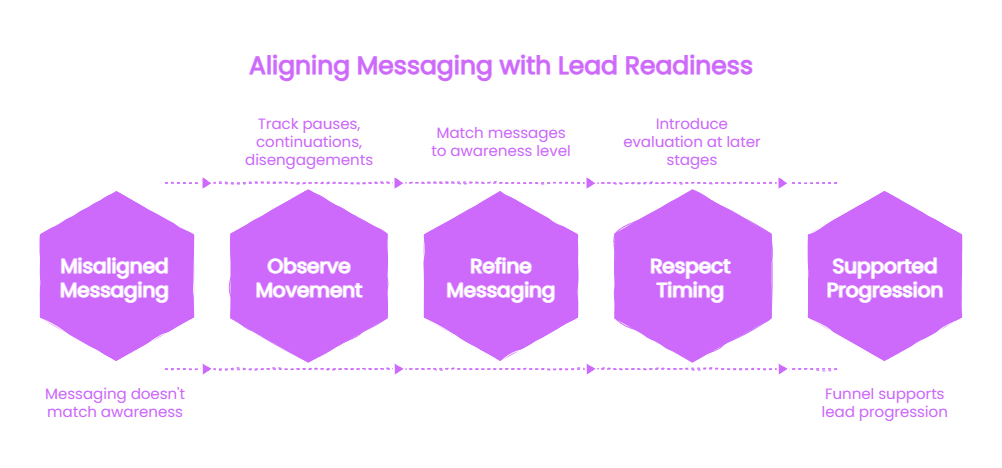
To work effectively with lead readiness, the focus must shift from labeling behavior to interpreting it accurately. Instead of assuming warmth based on interaction, attention is given to patterns of movement within the funnel. Where people pause, where they continue, and where they disengage provides insight into their level of readiness. These patterns are more reliable than isolated actions because they reflect how the sequence is being received. This allows for a clearer understanding of what is actually happening.
Alignment then becomes the primary focus, rather than adjustment for the sake of performance. Messaging is refined to match the level of awareness that is present. Early interactions support understanding and recognition, while later stages introduce evaluation and decision. Timing is respected rather than forced. When this alignment is in place, the funnel no longer needs to compensate for gaps in readiness. It becomes a structure that supports progression instead of attempting to create it.
In Closing
Warmth is not a label that can be assigned from the outside based on visible behavior. It is a condition that develops through clarity, relevance, trust, and time. Funnels do not create this condition, and they cannot accelerate it beyond what is present. They reveal whether it exists by showing how people move through what has been built. When this is understood, expectations around performance begin to stabilize.
Movement is no longer forced or assumed based on surface level engagement. It is observed and interpreted in relation to readiness. When readiness is present, progression becomes consistent and grounded. When it is not, the funnel shows where understanding has not yet formed. This is not a failure of the system, but an accurate reflection of reality. When that reality is understood, action becomes appropriate rather than premature, and the funnel can function as it was designed to.