
Treating Funnels Like Isolated Assets Instead of Systems
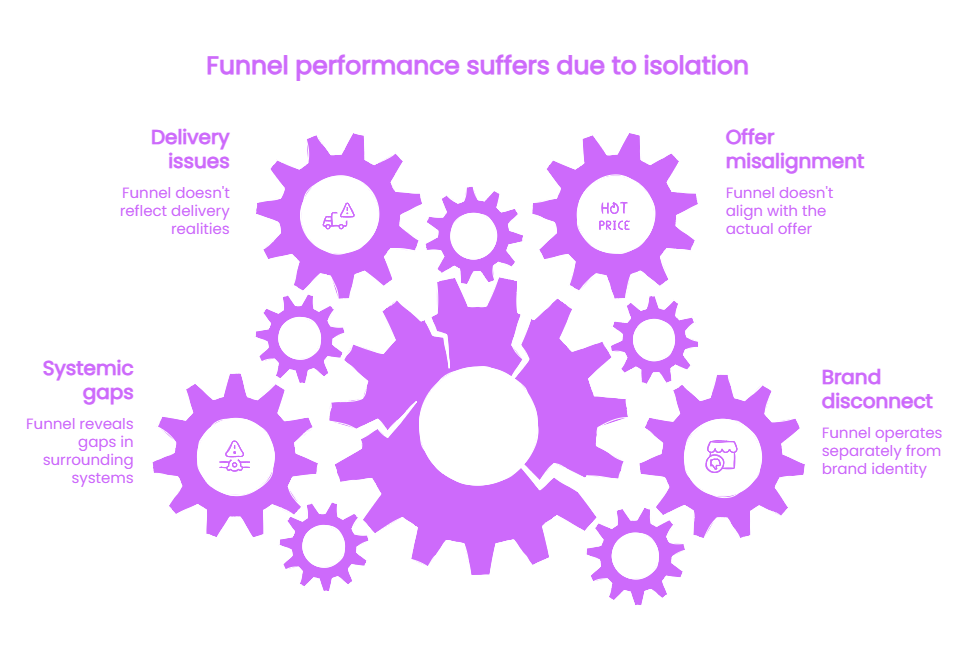
When a funnel is treated in isolation, it often appears functional on the surface. Traffic enters, and engagement can initially seem stable. However, something feels disconnected across the broader experience. The funnel begins to operate separately from the brand, the offer, and the delivery it represents. This separation creates a sense of fragmentation that is not immediately visible in metrics. Users move through the funnel, but their experience does not feel anchored to anything beyond it. Over time, this lack of alignment becomes noticeable in how outcomes unfold.
The instinct is often to evaluate the funnel as the sole point of responsibility. Performance is attributed entirely to what happens within its structure. However, this view ignores the systems that feed into and extend beyond it. The funnel is not an independent mechanism but a connected component of a larger whole. When it is treated as standalone, it inherits gaps from its surrounding system. These gaps are not created inside the funnel but revealed through it. The issue is not the funnel itself, but its isolation from the system it belongs to.
What Isolation Actually Is
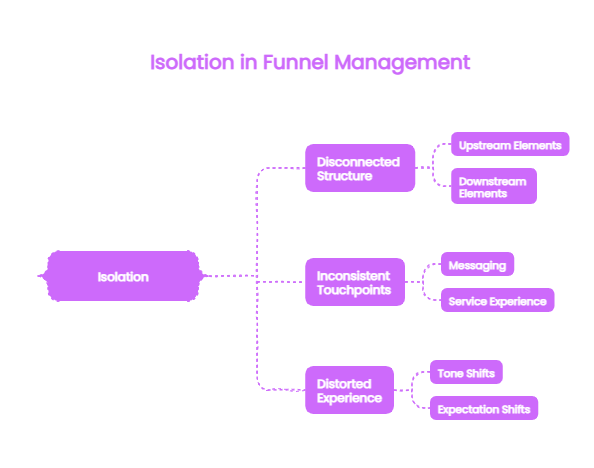
Isolation is the treatment of a funnel as an independent asset rather than part of a connected structure. It assumes the funnel begins and ends within its own boundaries. In this model, upstream elements like brand and messaging are disconnected from downstream elements like delivery and experience. Each component is built separately without shared alignment. The funnel is designed without reference to what precedes or follows it. This creates a structure that appears complete but functions in fragmentation. The system becomes divided into unrelated parts.
When isolation is present, consistency across touchpoints breaks down. Messaging inside the funnel does not reflect external communication. The promise presented in the funnel may not match the actual service experience. Users encounter shifts in tone, expectation, or clarity as they move through the system. These shifts are not intentional but structural. The funnel cannot compensate for missing alignment outside of itself. Isolation creates distortion that the funnel alone cannot resolve.
What It Looks Like in Practice
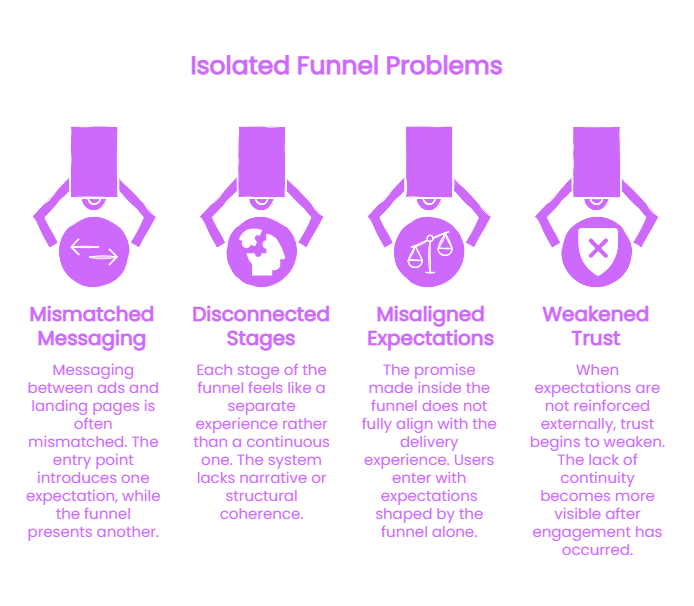
In practice, isolated funnels often show mismatched messaging between ads and landing pages. The entry point introduces one expectation, while the funnel presents another. The language used at the awareness stage does not match the language used at conversion points. This creates confusion before the user even completes the journey. The disconnect continues as the funnel progresses. Each stage feels like a separate experience rather than a continuous one. The system lacks narrative or structural coherence.
Another expression of this distortion appears after conversion. The promise made inside the funnel does not fully align with the delivery experience. Users enter with expectations shaped by the funnel alone. When those expectations are not reinforced externally, trust begins to weaken. The lack of continuity becomes more visible after engagement has occurred. This creates a gap between acquisition and fulfillment. The funnel reflects this inconsistency rather than resolving it.
How Funnels Reveal This Distortion
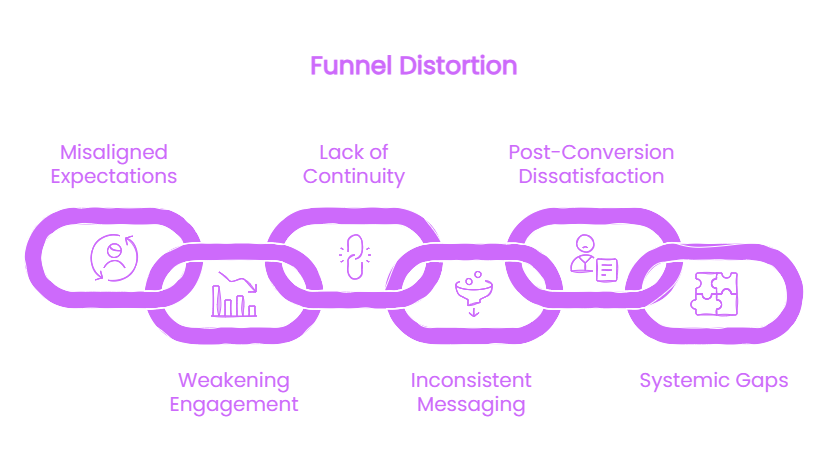
Funnels reveal isolation through misaligned expectations across stages. Users may enter with clarity but exit with hesitation. Engagement patterns appear strong at the beginning but weaken near commitment points. Drop offs often occur not from lack of interest but from lack of continuity. The message that brought the user in does not fully support the decision required at the end. This misalignment becomes visible in behavioral patterns. The funnel exposes what the system outside of it fails to support.
Post conversion behavior further reveals this distortion. Users who complete the funnel may express uncertainty or dissatisfaction afterward. This is not caused by the funnel alone but by the system it is disconnected from. The experience inside the funnel does not match the experience outside of it. This creates friction after engagement rather than during it. The funnel becomes a reflection point for broader systemic gaps. It reveals fragmentation that exists beyond its structure.
Why Funnel Optimization Doesn’t Fix It
Optimizing the funnel in isolation does not resolve systemic misalignment. Improvements within the funnel cannot correct disconnects that exist outside of it. Changes to headlines, sequences, or design do not address broken continuity. The funnel may perform better temporarily, but the underlying issue remains unchanged. This creates a cycle of adjustment without resolution. Effort is applied to the wrong layer of the system. The funnel is refined while the system remains fragmented.
As a result, optimization efforts often produce diminishing returns. Each improvement inside the funnel has limited impact because the external structure remains misaligned. The funnel is being asked to compensate for gaps it did not create. This places unnecessary weight on its internal components. Performance improvements plateau despite increased effort. The issue is not optimization quality but structural scope. The funnel cannot resolve what exists beyond its boundaries.

Where System Alignment Must Be Established
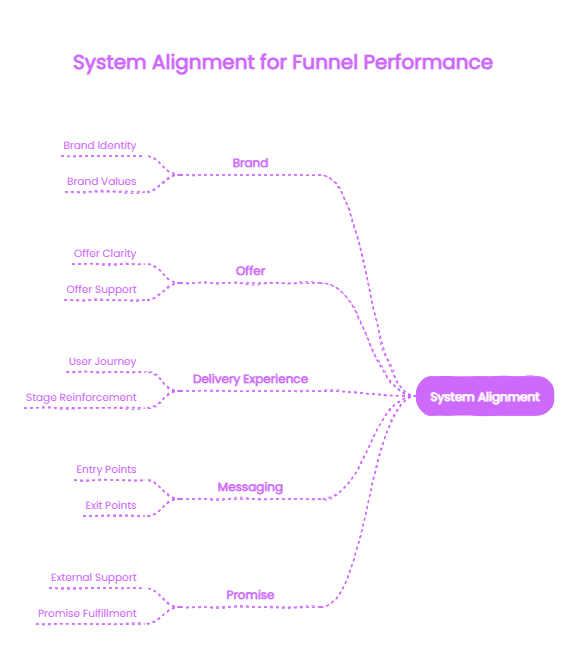
System alignment must be established before funnel performance can stabilize. The funnel must be connected to the brand, the offer, and the delivery experience. Each part of the system must reflect the same underlying structure. Messaging should remain consistent across all entry and exit points. The promise made inside the funnel must be supported outside of it. Without this alignment, the funnel cannot function as intended. It becomes a disconnected expression rather than a unified system.
When alignment is present, continuity becomes visible across the entire journey. The user experience feels coherent from first touch to final outcome. Each stage reinforces the next without contradiction. The funnel becomes an extension of the system rather than a separate structure. This creates stability in both perception and performance. The system begins to operate as a unified whole. Clarity at the system level produces clarity inside the funnel.
Working With the Funnel
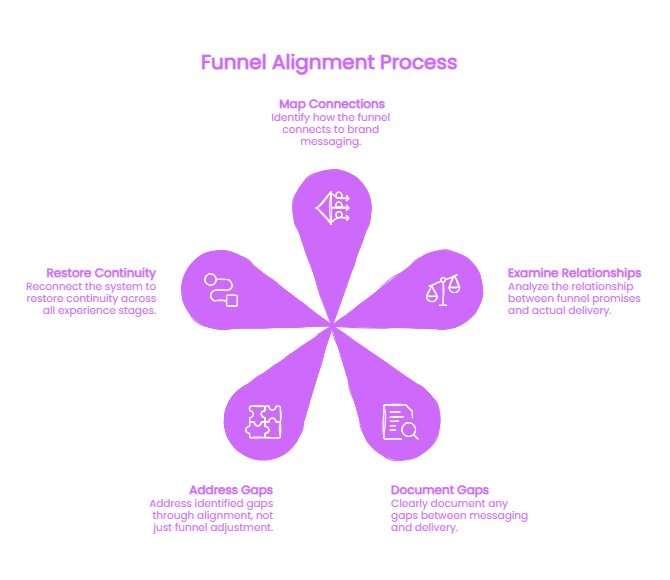
Working with isolation requires mapping the full system around the funnel. The first step is to identify how the funnel connects to brand messaging. Then the relationship between funnel promises and actual delivery must be examined. Any gaps between these areas should be clearly documented. Once identified, these gaps can be addressed through alignment rather than adjustment. The goal is not to change the funnel alone but to reconnect the system. This restores continuity across all stages of experience.
As alignment is reintroduced, clarity begins to stabilize across the funnel. Messaging becomes consistent from entry to exit. User expectations match what is delivered beyond the funnel. Engagement becomes more reliable because continuity is restored. The funnel no longer carries the burden of isolation. It functions as part of a coordinated system. This creates coherence across both experience and performance.
In Closing
Funnels do not operate independently from the systems they belong to. When treated as isolated assets, they reveal fragmentation rather than clarity. Performance issues often originate outside the funnel itself. Misalignment between components creates distortion within the funnel’s behavior. Optimization within isolation cannot resolve structural gaps. The funnel reflects the system it is embedded within. Stability requires alignment across all connected parts.