
The Risk of Copy Without Context in Funnel Builds
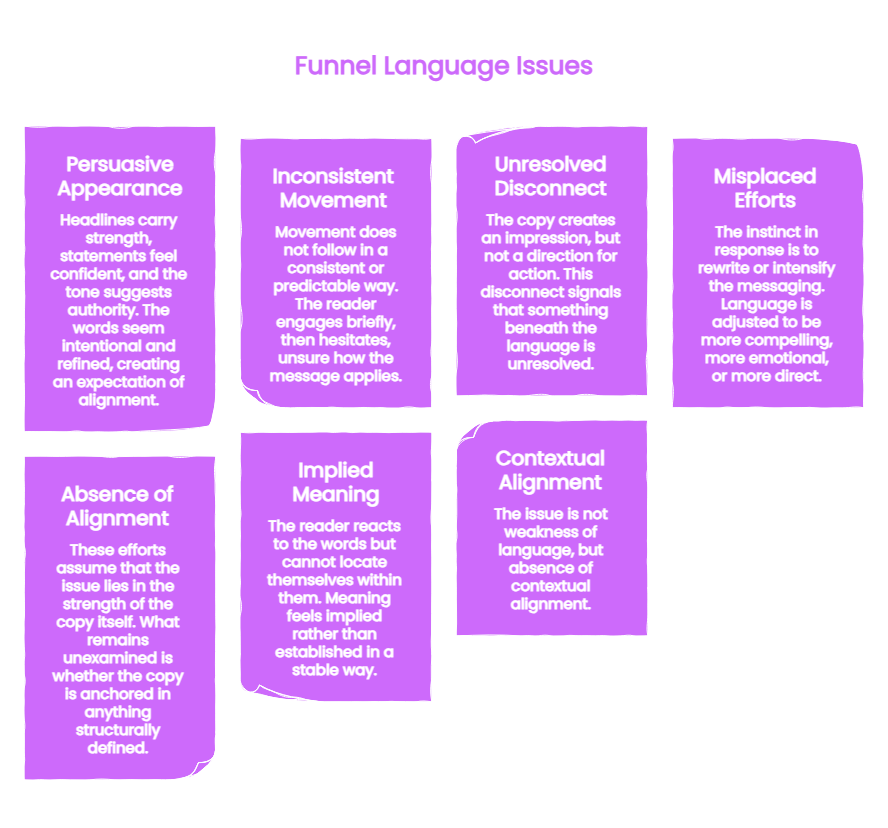
When encountering a funnel, the language may appear persuasive at first glance. Headlines carry strength, statements feel confident, and the tone suggests authority. The words seem intentional and refined, creating an expectation of alignment. Yet movement does not follow in a consistent or predictable way. The reader engages briefly, then hesitates, unsure how the message applies. The copy creates an impression, but not a direction for action. This disconnect signals that something beneath the language is unresolved.
The instinct in response is to rewrite or intensify the messaging. Language is adjusted to be more compelling, more emotional, or more direct. These efforts assume that the issue lies in the strength of the copy itself. What remains unexamined is whether the copy is anchored in anything structurally defined. The reader reacts to the words but cannot locate themselves within them. Meaning feels implied rather than established in a stable way. The issue is not weakness of language, but absence of contextual alignment.
What Copy Without Context Actually Is
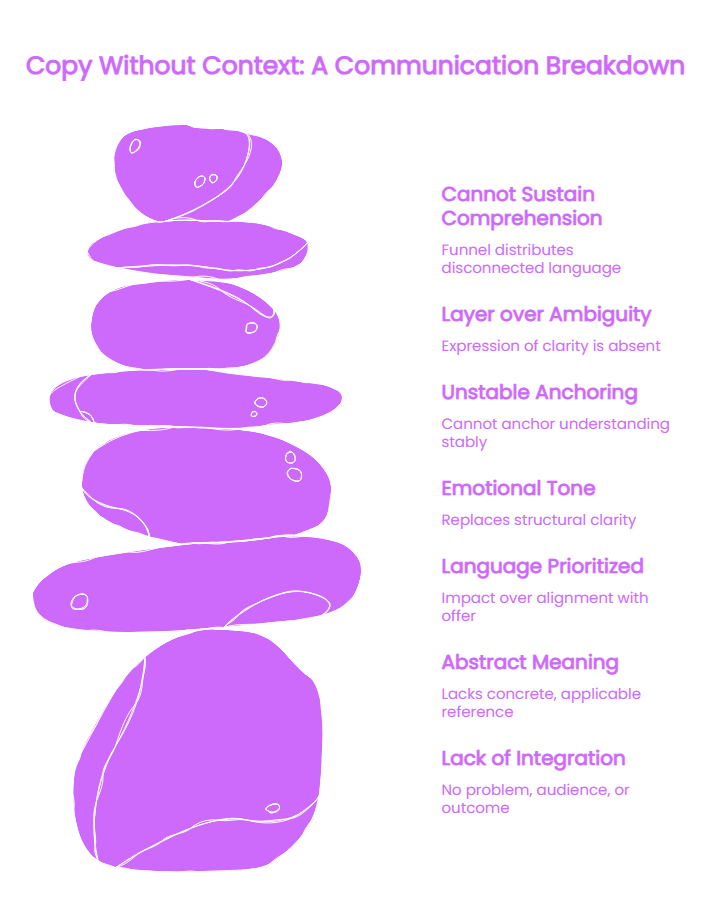
Copy without context is messaging that exists independently of the structure it is meant to communicate. It is written without full integration of the problem, the audience, and the outcome. The language may be compelling in isolation, but it does not connect to a defined framework. Instead of clarifying meaning, it performs persuasiveness without grounding. It signals confidence without establishing substance that can be understood. The reader encounters statements that sound complete but lack a clear reference point. Meaning becomes abstract rather than concrete and applicable.
This type of copy often emerges when language is prioritized before definition. Words are selected for impact rather than alignment with the offer. Emotional tone replaces structural clarity and coherence. The result is communication that feels polished but remains disconnected from meaning. Without context, the copy cannot anchor understanding in a stable way. It becomes a layer placed over ambiguity rather than an expression of clarity. The funnel then distributes language that cannot sustain comprehension or decision.
What It Looks Like in Practice
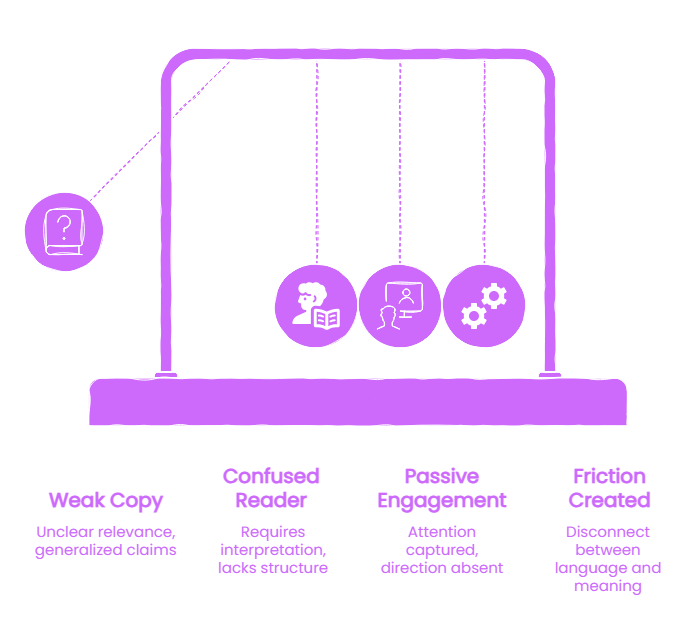
In practice, copy without context appears as strong statements without clear relevance. Headlines may promise transformation but fail to specify what is being transformed. Body text may use emotionally charged language that resonates briefly but does not inform. Claims are often generalized, capable of applying to many situations without defining one. The reader encounters language that sounds meaningful but requires interpretation to become useful. Each sentence stands on its own but does not contribute to a coherent structure. The overall message feels active but remains undefined.
This produces a distinct response in the reader’s behavior. Attention is captured, but direction is absent from the experience. The reader may pause, reread, or attempt to connect ideas that are not structurally linked. Engagement becomes exploratory rather than intentional or decisive. Interest is present, but it does not convert into movement. The copy invites reaction but does not guide progression toward a decision. The disconnect between language and meaning becomes the primary source of friction.
How Funnels Reveal This Distortion
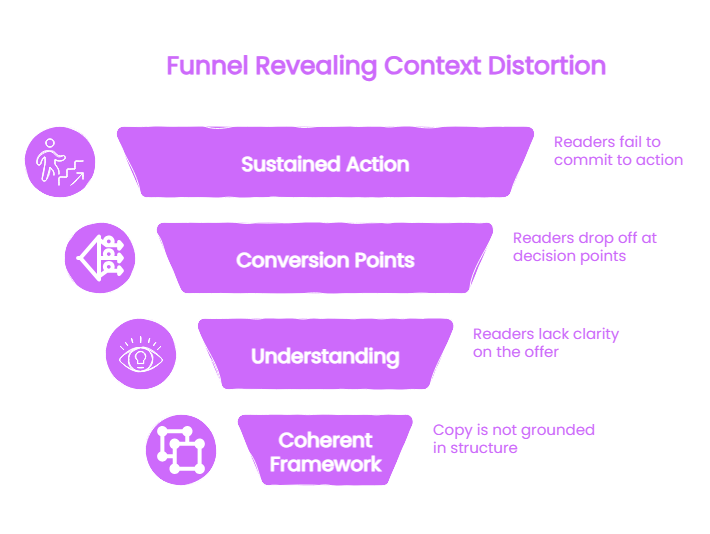
Funnels make the absence of context visible through observable behavior. Initial engagement may appear strong, with clicks or opens indicating interest. However, this engagement does not extend into sustained action or commitment. Readers move through early stages but fail to convert at decision points. The funnel reflects this as a drop in progression despite apparent attention. The language has captured interest but has not established understanding. This reveals that the message is not grounded in structure.
This pattern exposes the gap between message and meaning within the funnel. The reader is responding to tone or promise rather than a defined offer. Each stage requires greater clarity, and without it, hesitation increases. The disconnect becomes more pronounced as the sequence progresses. What begins as curiosity does not resolve into a clear decision. The funnel reflects this instability as inconsistent movement. It becomes evident that the copy is not anchored in a coherent framework.
Why Better Copy Doesn’t Resolve It
Attempts to improve performance often focus on strengthening the copy itself. Headlines are rewritten to be more compelling and emotionally engaging. Language is intensified to create urgency and perceived value. These adjustments assume that stronger phrasing will produce better results. In practice, they amplify the existing misalignment rather than resolve it. The copy becomes more forceful without becoming more clear or grounded. The absence of context remains unchanged beneath the surface.
Stronger language without grounding increases cognitive friction for the reader. The reader encounters more assertive claims but still lacks a framework to understand them. This creates tension rather than clarity within the funnel experience. Engagement may increase temporarily, but decision making does not improve. The funnel feels more active but remains structurally unstable. Refinement of language cannot compensate for missing definition. Without context, even persuasive copy remains disconnected from action.

Where Context Must Be Established
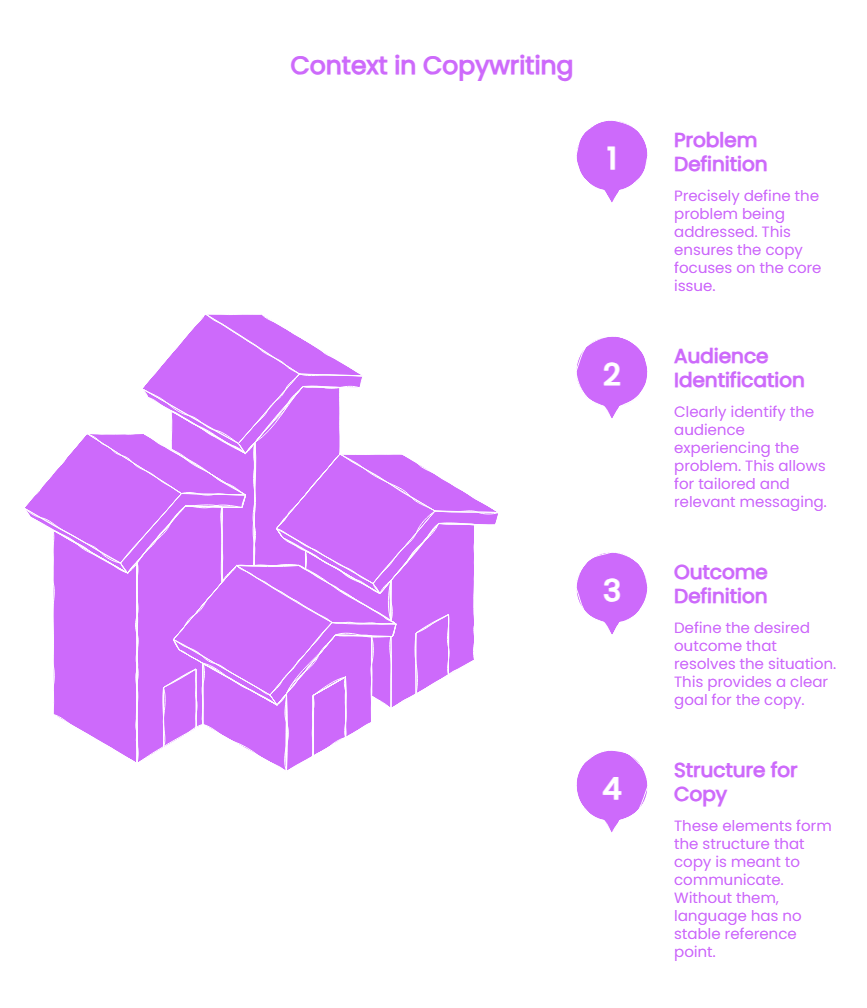
Context must be established before copy is written within the funnel. It exists in the precise definition of the problem being addressed. It includes a clearly identified audience experiencing that problem. It also requires a defined outcome that resolves the situation. These elements form the structure that copy is meant to communicate. Without them, language has no stable reference point. Copy must emerge from this structure rather than being layered on top.
When context is defined, copy becomes clear and direct in its function. Each statement has a purpose tied to a specific element. The reader understands what is being addressed and why it matters. Relevance becomes immediate rather than assumed or implied. Interpretation is no longer required for comprehension. The funnel becomes a sequence of understanding rather than persuasion. Context stabilizes meaning and allows language to function properly.
Working With the Funnel
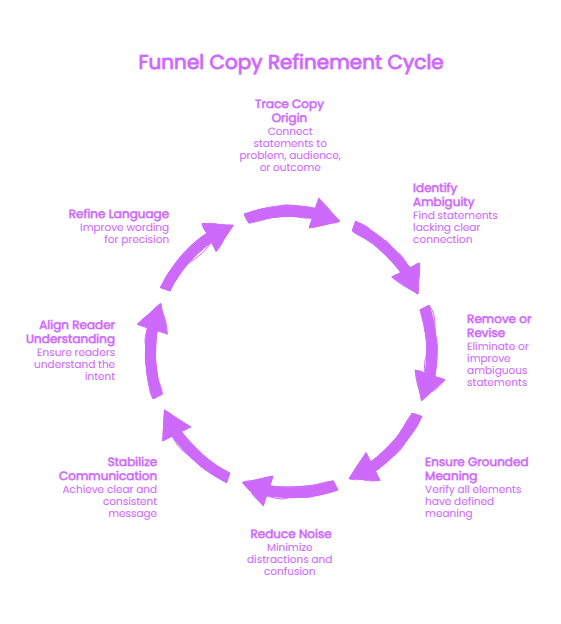
Working with this distortion requires tracing copy back to its structural origin. Each statement should be examined for its connection to problem, audience, or outcome. If it cannot be clearly tied to one of these elements, it introduces ambiguity. Removing or revising such statements restores clarity and coherence. The objective is to ensure that every element is grounded in defined meaning. This process reduces noise and stabilizes communication. The funnel begins to reflect structure rather than assumption.
This approach allows clarity to emerge through alignment rather than effort. As ambiguity is removed, the message becomes more legible. The reader no longer needs to interpret or infer meaning. Movement becomes aligned with understanding and intent. Refinement can then occur at the level of language with precision. Copy evolves as an expression of clarity rather than a substitute for it. The funnel begins to function as a coherent system of communication.
In Closing
Copy communicates clarity, but it does not create it independently. When grounded in defined context, it supports understanding and decision making. When detached from structure, it becomes noise regardless of quality. The strength of language cannot replace the presence of meaning. A funnel built on ungrounded copy may appear persuasive at first. However, it cannot sustain alignment or consistent progression. Engagement may occur, but it does not lead to resolution.
When context leads, copy becomes precise and effective in its role. The reader understands immediately what is being communicated. Movement through the funnel becomes natural and predictable. Decisions occur without hesitation or confusion. When context is absent, the funnel reflects fragmentation and instability. The distinction lies not in how the copy sounds, but in what it is anchored to. Clarity must exist before language can carry it forward.