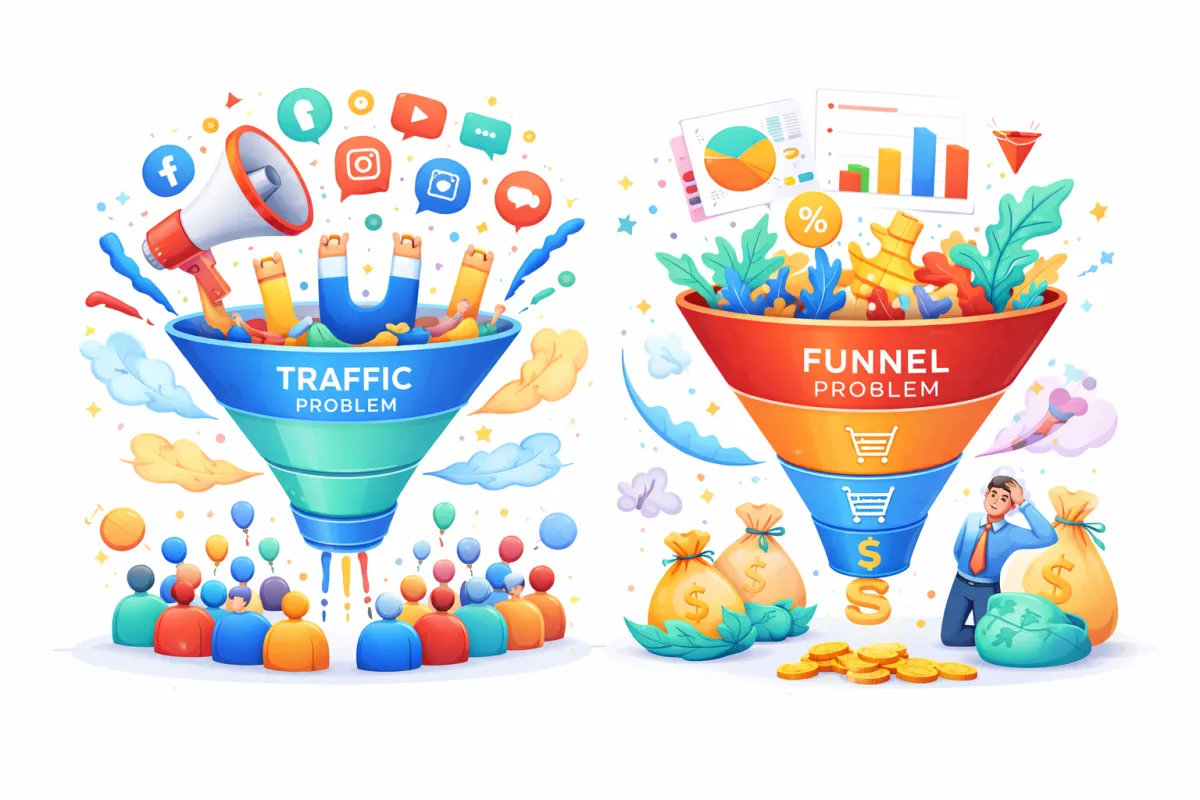
The Difference Between Traffic Problems and Funnel Problems
Results dip and the first response is to increase traffic. The numbers are lower than expected, conversions feel inconsistent, and the simplest explanation is visibility. If more people saw the offer, performance would stabilize. If reach expanded, revenue would follow. Traffic is measurable, adjustable, and immediate. It feels like action. And action feels safer than restraint. The confusion between traffic and funnels is not a marketing misunderstanding. It is a structural misunderstanding.
When performance declines or stagnates, most business owners assume the issue is visibility. They believe that if more people were seeing the offer, revenue would correct itself. This assumption feels logical because traffic is visible. It can be measured, purchased, increased, and displayed in dashboards. It creates movement that looks like growth. Traffic and funnels do not perform the same function inside a business system. They operate at different layers of the architecture. When those layers are confused, the response to underperformance becomes misdirected.

What Traffic Actually Governs
Traffic governs exposure. It determines how many people encounter your brand, your message, or your offer within a given period of time. Its function is expansion. It increases the number of entry points into your ecosystem and widens the top of your system. When traffic increases, awareness increases. When traffic decreases, awareness contracts. This is a quantitative lever. It affects how many people see you, not how they understand you.
What traffic does not govern is progression. It does not determine what happens after attention is captured or whether that attention is retained. It does not ensure that your positioning is clear, that your authority is credible, or that your offer aligns with the readiness of the audience encountering it. Traffic multiplies attention, but it does not organize it into movement. If the underlying system lacks clarity, increasing traffic simply increases the number of people experiencing that lack of clarity. Volume amplifies structure. It does not repair it.
What a Funnel Actually Governs
A funnel governs movement. It is the structured pathway that determines how someone transitions from awareness to consideration and from consideration to decision. It organizes information in deliberate sequence and controls how context is layered over time. Where traffic expands entry, the funnel governs advancement. It determines what someone sees first, what they understand next, and when they are invited to act. This is not about pages or emails in isolation; it is about progression by design.
A properly structured funnel assumes that attention alone is insufficient for decision making. It recognizes that trust, clarity, and readiness develop in stages and must be supported by sequence. Where traffic answers the question of how many people are entering, the funnel answers the question of what happens to them once they do. When someone claims they have a traffic problem, they are often describing stagnation at the top of the system. When they claim they have a funnel problem, they are often describing drop off within it. These are distinct structural constraints, even if they feel similar at the surface level.

The Cost of Misdiagnosis
If people are not entering your ecosystem in meaningful numbers, structural refinement inside the funnel will not create revenue. A well designed journey cannot convert individuals who never arrive. In this scenario, the constraint is exposure, and increasing traffic is an appropriate intervention because the top of the system is underfed. The issue is quantitative. Without sufficient entry, even strong progression mechanics remain underutilized. Scale cannot occur without input.
However, if people are entering and not progressing, the constraint is not exposure but coherence. It may be that the offer lacks clarity, that authority has not been sufficiently established, or that the audience’s readiness has been misjudged. In this case, increasing traffic only accelerates disengagement and amplifies inefficiency. Both scenarios produce the same visible symptom of disappointing results, but the corrective action is opposite. Misdiagnosis leads to motion without improvement, and intensity replaces structural accuracy.
The Responsibility of Distinction
Distinguishing between multiplication and progression is a leadership responsibility. Traffic scales entry. Funnels govern advancement. Offers anchor decision. Authority stabilizes trust. Each layer performs a different function within the business architecture, and each must be evaluated independently before intervention occurs. Without this distinction, adjustments become reactive rather than deliberate.
If you claim to operate a business rather than chase campaigns, you must learn to diagnose the correct layer before applying pressure. You must resist increasing volume when clarity is unresolved, and resist restructuring when visibility is insufficient. Restraint is as strategic as expansion. Momentum is restored when effort is applied to the actual constraint rather than the most visible one. Precision, not activity, is what stabilizes growth.

Intervention at the Correct Layer
Before increasing budget, rewriting copy, or redesigning pages, evaluate the constraint with precision. Look at your system and determine where stagnation is occurring. Are people failing to enter your ecosystem, or are they entering and failing to advance? These are not interchangeable conditions. One is a volume constraint. The other is a structural constraint. Your response must match the layer that is underperforming.
Examine entry metrics independently from progression metrics. Separate exposure from movement. If traffic is low but conversion from lead to client is stable, the system requires expansion. If traffic is consistent but progression breaks between stages, the system requires refinement. Diagnosis must precede intervention. Without structural distinction, every adjustment becomes reactive and results become inconsistent.
In Closing
Traffic and funnels are not competing concepts. They are sequential functions within a larger architecture. One governs how many enter. The other governs how many advance. Confusing them creates cycles of effort without correction because the wrong lever is repeatedly pulled.
Business stability does not come from increasing intensity. It comes from identifying the true constraint and responding at the correct structural layer. When exposure is the issue, expand it. When progression is the issue, repair it. Precision restores momentum. Clarity restores control.