
The Cost of Unstructured Edits in Live Funnels
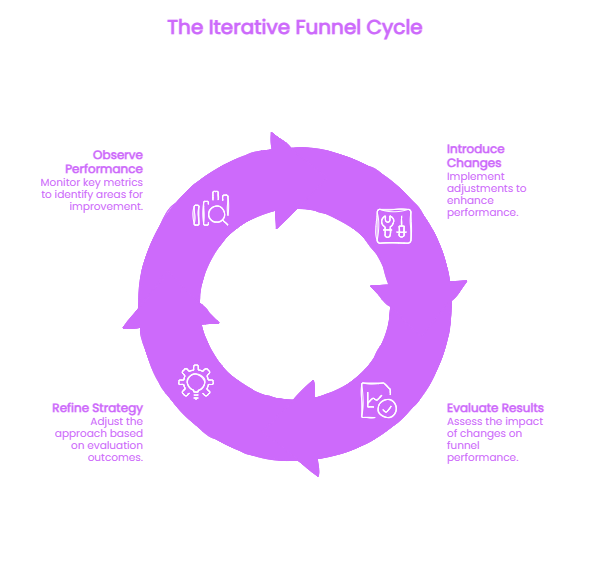
When a funnel is live, adjustments often begin in response to performance. Metrics are observed, and changes are introduced with the intention of improvement. These edits are frequent, reactive, and incremental in nature. One element is modified, then another, often without pause between decisions. Over time, the funnel becomes a collection of changes rather than a stable structure. Results begin to shift in ways that are difficult to interpret with confidence. The original clarity of the funnel becomes obscured by the accumulation of edits.
The instinct driving this process is to improve through iteration. Each change is intended to move performance in a positive direction. However, without structure, iteration loses its ability to produce insight. The relationship between cause and effect becomes unclear and unreliable. Improvements cannot be confidently identified or repeated. The funnel begins to behave unpredictably under continuous modification. The issue is not iteration itself, but the absence of structure within it.
What Unstructured Editing Actually Is
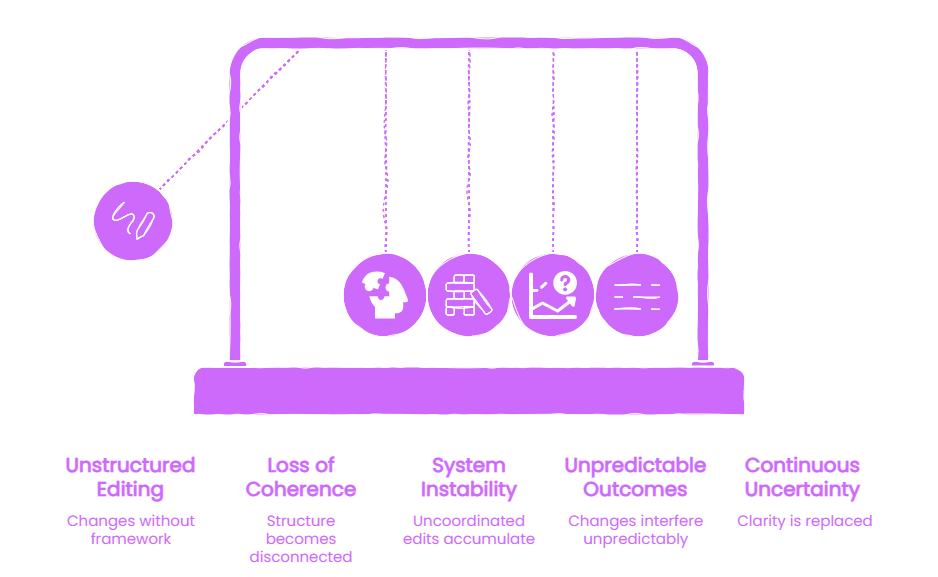
Unstructured editing is the process of making changes without a governing framework. Edits are introduced without a clear diagnostic basis or defined reasoning. Decisions are made in response to surface level observations rather than structured analysis. Each change exists independently, without connection to a broader system. The funnel is modified continuously without understanding causality. This results in a loss of coherence across the funnel’s structure. The system becomes unstable as layers of uncoordinated edits accumulate.
Without structure, edits cannot be evaluated with accuracy or consistency. There is no stable baseline against which performance can be measured. Changes overlap and interfere with one another in unpredictable ways. The outcome of any single adjustment becomes impossible to isolate. The funnel shifts in multiple directions at the same time. This creates a system that cannot be read or understood clearly. Unstructured editing replaces clarity with continuous uncertainty.
What It Looks Like in Practice
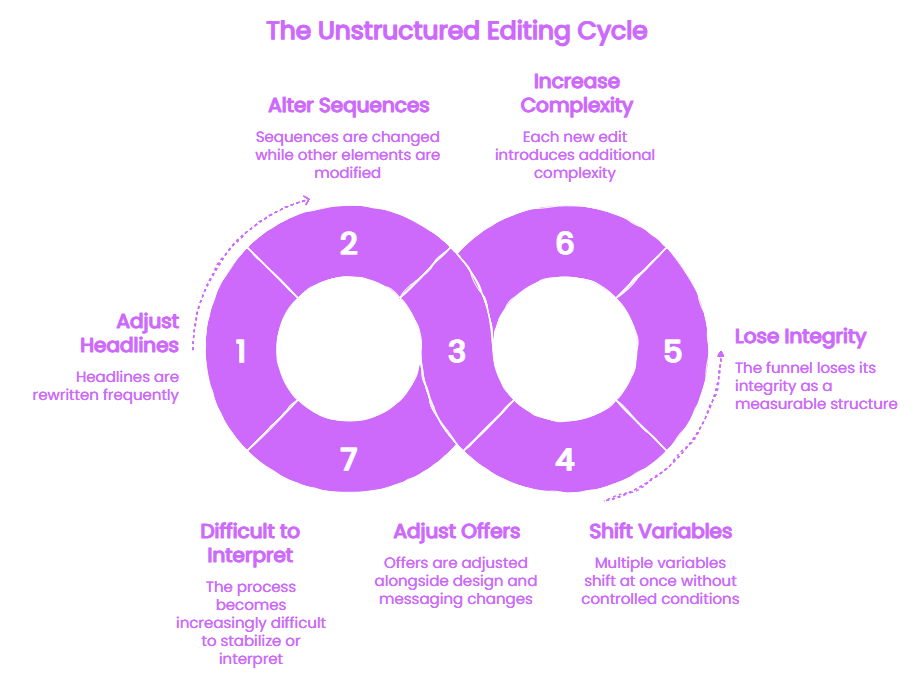
In practice, unstructured editing appears as constant adjustments across the funnel. Headlines are rewritten frequently without documentation of prior versions. Sequences are altered while other elements are being modified simultaneously. Offers are adjusted alongside changes in design and messaging. Multiple variables shift at once without controlled conditions. There is no record of why changes were made or what they were intended to test. The funnel becomes a moving target rather than a defined system.
This creates an environment where patterns cannot be reliably identified. Performance data reflects overlapping changes rather than isolated effects. Improvements may appear temporarily but cannot be traced to a specific cause. Declines in performance cannot be attributed to any single factor. The funnel loses its integrity as a measurable structure. Each new edit introduces additional complexity into the system. The entire process becomes increasingly difficult to stabilize or interpret.
How Funnels Reveal This Distortion
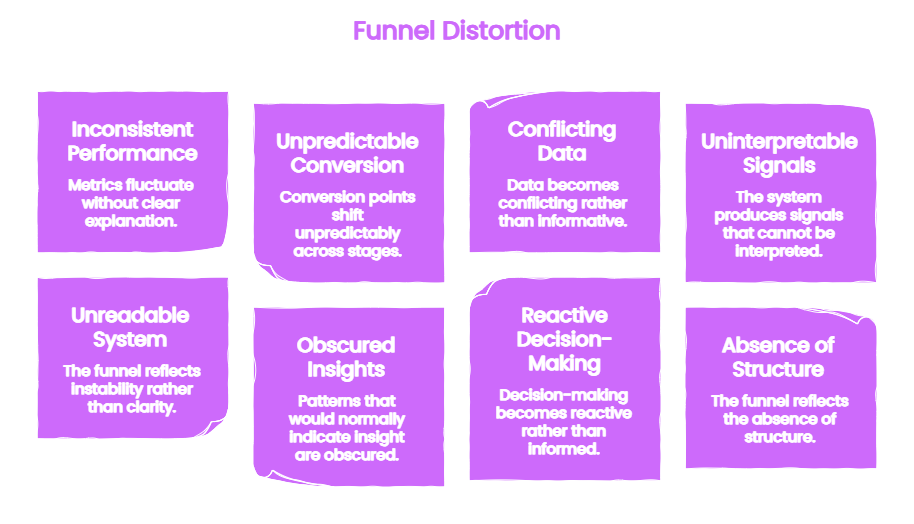
Funnels reveal unstructured editing through inconsistent performance patterns. Metrics fluctuate without a clear explanation or identifiable trend. Engagement may increase in one area while decreasing in another. Conversion points shift unpredictably across different stages. Data becomes conflicting rather than informative or directional. The system produces signals that cannot be interpreted with confidence. The funnel reflects instability rather than clarity.
This distortion makes the funnel unreadable as a system. There is no reliable way to determine what is working. Each data point is influenced by multiple overlapping changes. Patterns that would normally indicate insight are obscured. Decision making becomes reactive rather than informed. The funnel no longer provides guidance through its behavior. It reflects the absence of structure in its construction.
Why More Testing Doesn’t Fix It
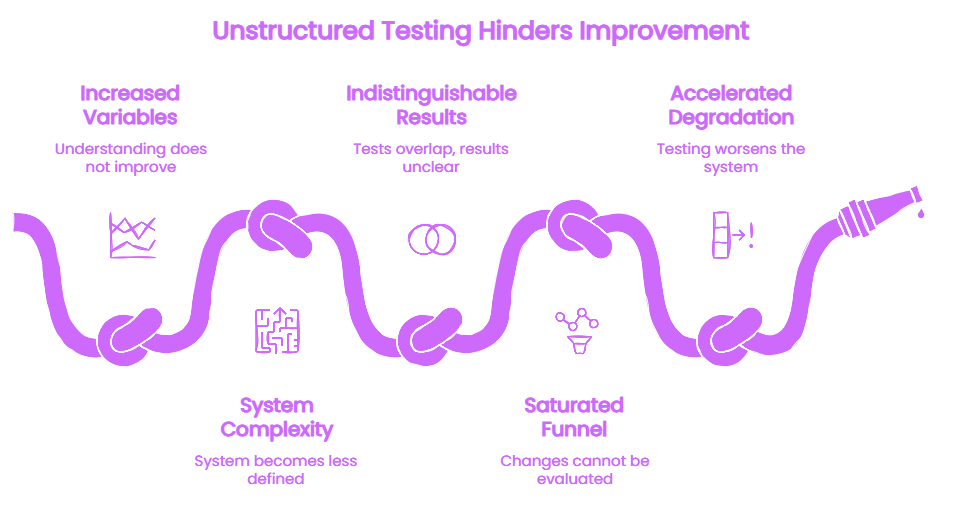
Increasing the volume of testing is often seen as the solution. More variations are introduced in an attempt to identify what performs best. Additional elements are tested simultaneously across different parts of the funnel. This approach assumes that more data will produce clarity. In reality, it compounds the existing confusion. The number of variables increases without improving understanding. The system becomes more complex without becoming more defined.
Testing without structure replaces insight with noise. Data accumulates, but it does not resolve uncertainty. Each test overlaps with others, making results indistinguishable. The funnel becomes saturated with changes that cannot be evaluated independently. Effort increases while clarity decreases. The process appears active but remains ineffective. Without structure, testing accelerates degradation rather than improvement.
Where Structure Must Be Established
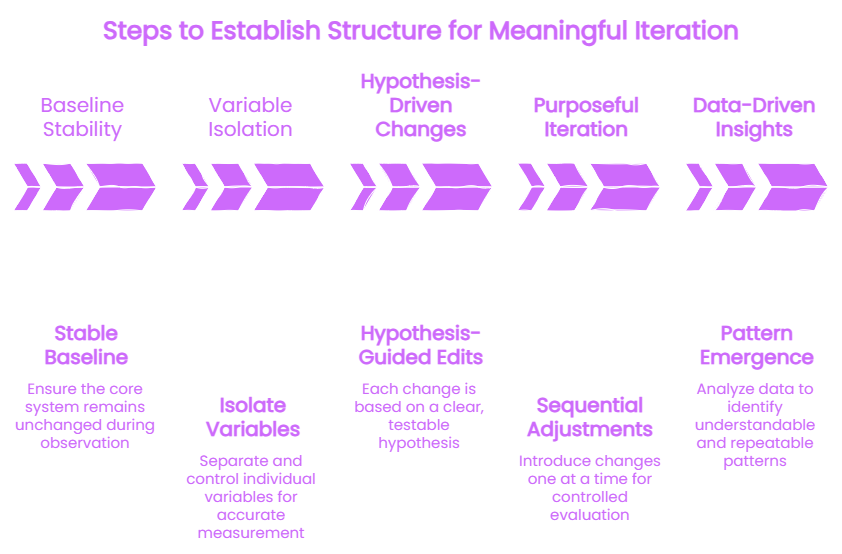
Structure must be established before meaningful iteration can occur. It begins with a stable baseline that remains unchanged during observation. Variables must be isolated so that their impact can be measured accurately. Each change should be guided by a defined hypothesis. The purpose of the edit must be clear before it is implemented. This creates a controlled environment for evaluation. Structure enables the funnel to produce interpretable results.
With structure in place, iteration becomes purposeful rather than reactive. Changes are introduced sequentially rather than simultaneously. Each adjustment can be measured against a consistent baseline. Data becomes a source of insight rather than confusion. Patterns emerge that can be understood and repeated. The funnel regains its integrity as a system. Clarity in process allows clarity in performance to follow.
Working With the Funnel
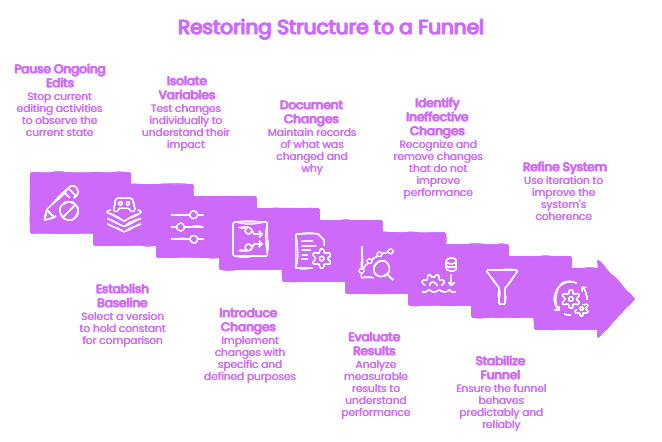
Restoring structure requires stabilizing the funnel before introducing new changes. The first step is to pause ongoing edits and observe the current state. A clear baseline must be established by selecting a version to hold constant. From this point, variables can be isolated and tested individually. Each change should be introduced with a specific and defined purpose. Documentation must be maintained to track what was changed and why it was changed. This creates a controlled framework for evaluation and learning.
As structure is reintroduced, clarity begins to return to the system. Each adjustment produces measurable results that can be understood. Patterns emerge that indicate what improves performance and what does not. Ineffective changes can be identified and removed with confidence. The funnel becomes stable and predictable again in its behavior. Iteration becomes a tool for refinement rather than disruption. The system begins to function as an integrated and coherent whole.
In Closing
Iteration without structure produces distortion within a funnel system. Continuous changes without a framework create instability and confusion. The relationship between cause and effect becomes unclear over time. Data loses its ability to inform meaningful decision making. The funnel reflects inconsistency rather than clarity in its outcomes. Effort increases without producing reliable or repeatable improvement. The system degrades under the weight of uncoordinated and reactive edits.
Clarity in process is required before clarity in results can emerge. Structure provides the foundation for meaningful and effective iteration. When changes are controlled and intentional, insight becomes possible. The funnel begins to produce consistent and interpretable outcomes. Decision making becomes informed rather than reactive in nature. Stability allows improvement to occur with precision and confidence. The distinction lies in how iteration is governed and executed.