The Cost of Mislabeling Your Offer
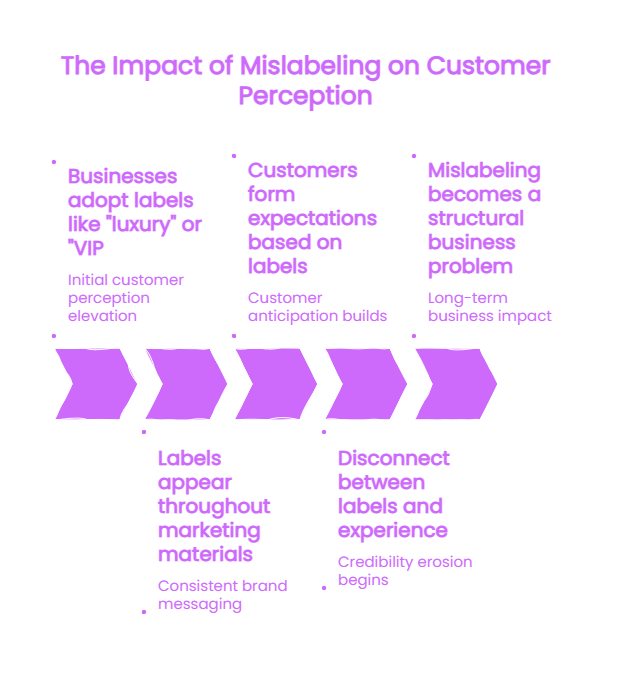
Businesses frequently adopt labels such as luxury, premium, high end, VIP, exclusive, or signature with the expectation that those words will immediately elevate how customers perceive their offers. These classifications often appear throughout websites, funnels, advertisements, and sales pages without a clear understanding of what they actually communicate. The language sounds refined and aspirational, creating an immediate impression of distinction before a customer experiences anything the business provides. Expectations begin forming the moment those labels are introduced. Customers naturally assume the experience, systems, communication, and delivery will consistently support the classification being presented. When that support is missing, the disconnect becomes increasingly difficult to ignore. Mislabeling is therefore not simply a branding mistake but a structural business problem that begins long before a purchase is made.
Classification influences interpretation before trust has the opportunity to develop. Every word used to describe an offer establishes assumptions about quality, expertise, consistency, responsiveness, and customer experience. Those assumptions shape how every future interaction will be evaluated. Customers are not simply purchasing a service or product. They are responding to the expectations created by the positioning itself. When the operational experience cannot consistently fulfill those expectations, credibility begins weakening immediately. The issue is not that ambitious positioning is inherently wrong. The issue is allowing positioning to communicate realities that the business has not yet operationally established.
What Mislabeling Actually Is
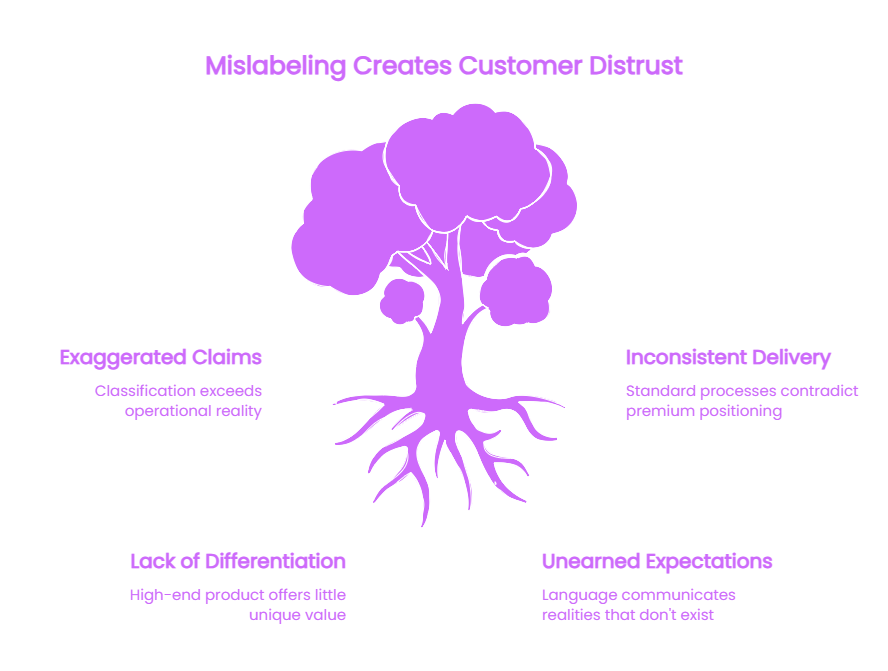
Mislabeling occurs when a business assigns a market classification that exceeds or contradicts its operational reality. The business may describe an offer as luxury while maintaining standard delivery processes, or position a service as premium without demonstrating the disciplined constraints that premium positioning requires. It may describe a product as high end while offering little measurable differentiation from competing alternatives. In each case, the classification promises more than the operational system consistently delivers. The words establish expectations that the business has not yet earned through execution. Customers begin evaluating the experience according to the classification rather than according to the intention behind it. The mismatch creates instability before the customer journey has fully begun.
Names are powerful because they establish meaning before evidence exists. Once a classification has been communicated, every interaction becomes proof that either confirms or contradicts that claim. Customers continuously compare the experience against what the positioning suggested would happen. Even small inconsistencies become more noticeable because expectations have already been elevated. Trust gradually shifts from confidence toward uncertainty whenever those expectations remain unsupported. The classification itself is rarely the problem. The problem is allowing language to communicate operational realities that do not yet exist consistently within the business.
What It Looks Like in Practice
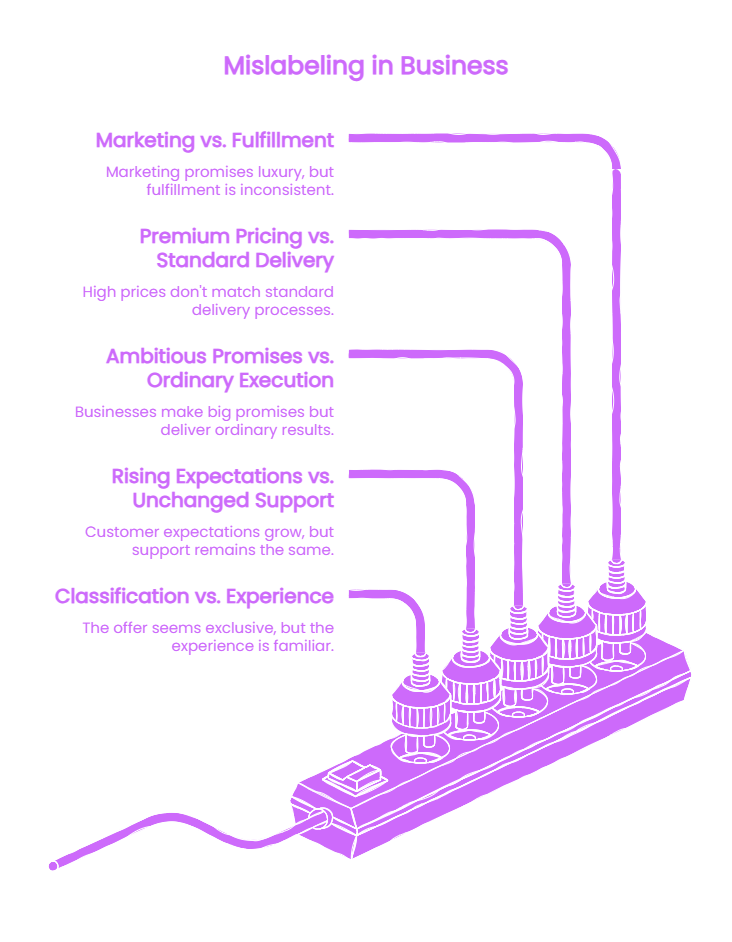
This distortion appears when businesses describe ordinary offers using extraordinary classifications. A standard coaching program becomes a luxury experience despite generic onboarding and reactive communication. A broadly targeted service is marketed as premium while attempting to accommodate every possible customer. An expensive offer is labeled high end even though measurable expertise, operational excellence, and differentiated outcomes remain unclear. Exclusive terminology is added without meaningful scarcity or intentional customer experience design. The language becomes increasingly sophisticated while the underlying systems remain largely unchanged. Customers receive a familiar experience wrapped in elevated positioning.
The disconnect becomes visible throughout the entire customer journey. Marketing communicates refinement while fulfillment feels inconsistent or unfinished. Premium pricing is paired with standard delivery processes that create little distinction from lower priced alternatives. Customers encounter ambitious promises but ordinary execution. Expectations continue rising while operational support remains relatively unchanged. The offer appears to belong to one classification while the experience consistently reflects another. Over time, the business begins relying on stronger language instead of stronger operational evidence.
How Funnels Reveal This Distortion
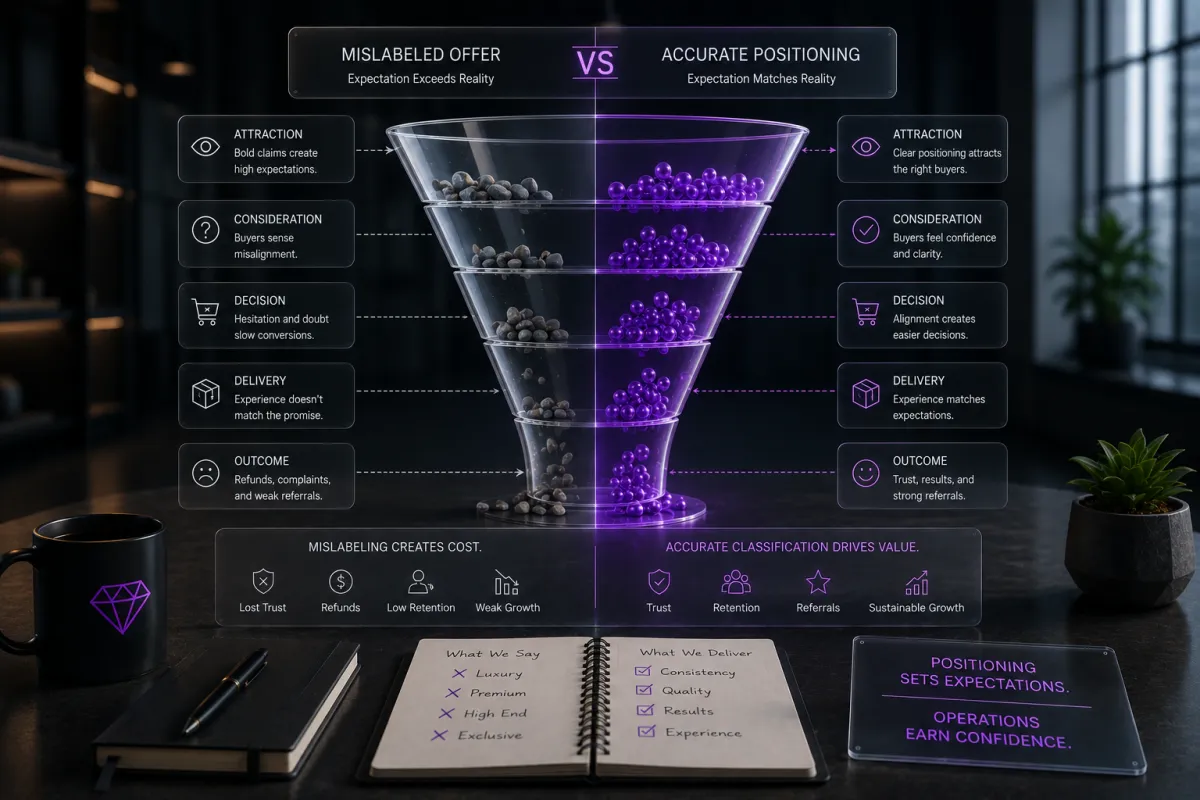
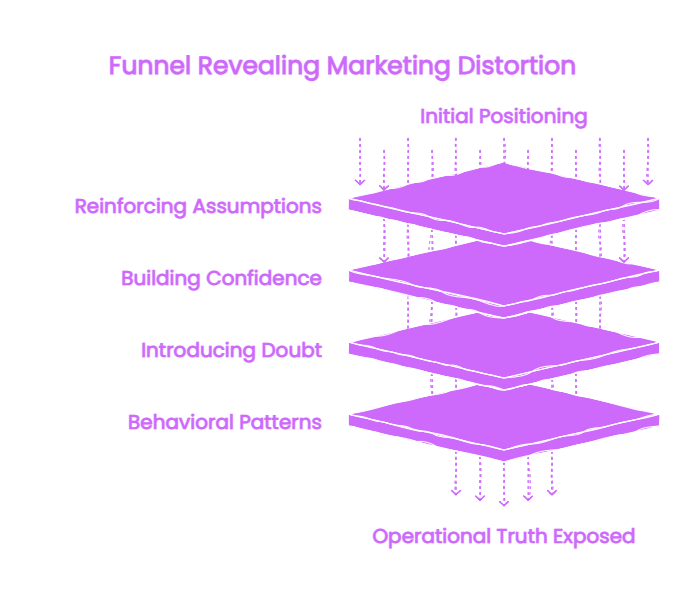
Funnels amplify positioning because every stage reinforces the assumptions introduced at the beginning of the buying journey. Once customers encounter luxury, premium, or high-end language, every page, email, call to action, and interaction is interpreted through that expectation. A well aligned funnel strengthens confidence because the experience continually confirms what the positioning originally communicated. A misaligned funnel gradually introduces doubt because operational evidence becomes inconsistent. Customers begin questioning whether the experience truly reflects the classification they were promised. The funnel exposes these inconsistencies by making expectations increasingly visible over time. What appears persuasive initially becomes difficult to sustain without operational alignment.
Behavioral patterns often reveal this distortion more clearly than customer feedback alone. Visitors hesitate despite expressing genuine interest in the offer. Questions increasingly focus on justification rather than implementation. Refund requests become more common because the experience failed to support elevated expectations. Referrals become inconsistent because enthusiasm weakens after purchase. Customer retention declines even when acquisition remains relatively stable. The funnel exposes where labels have moved beyond operational truth.
Why Better Marketing Doesn't Fix It
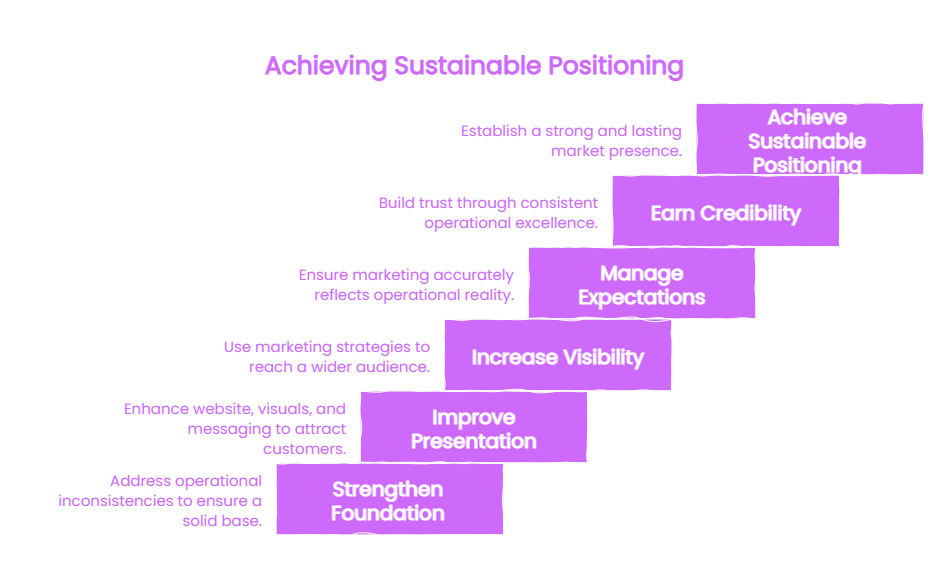
Businesses frequently respond to this problem by strengthening the presentation instead of strengthening the foundation. They redesign websites, improve visuals, refine messaging, invest in premium photography, or develop more persuasive copy. While these improvements may increase visibility and initial interest, they cannot eliminate operational inconsistency. Better marketing simply introduces more people to the same unsupported positioning. Increased exposure magnifies the consequences of misalignment rather than resolving it. Every improvement in visibility increases the number of customers evaluating the experience against elevated expectations. Marketing cannot consistently protect credibility when operations remain unchanged.
Persuasive communication is most effective when it accurately represents operational reality. Strong branding should amplify existing strengths rather than compensate for structural weaknesses. Classification gains credibility through consistent execution instead of repeated promotion. Businesses that attempt to market beyond their operational maturity often discover that greater visibility accelerates customer disappointment. Sustainable positioning cannot be created through messaging alone. Classification must first be earned through disciplined operational excellence before marketing communicates it at scale.
Where Accurate Classification Must Be Established
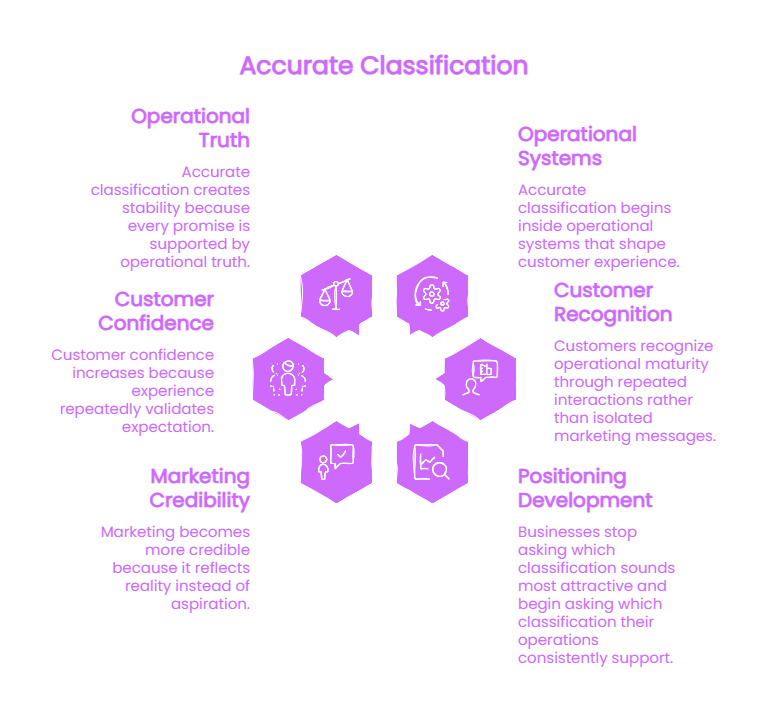
Accurate classification begins inside the operational systems that shape customer experience every day. Delivery quality, communication standards, fulfillment consistency, measurable outcomes, strategic focus, and operational discipline collectively establish what a business truly represents. These elements define classification long before branding introduces it publicly. Customers recognize operational maturity through repeated interactions rather than isolated marketing messages. Every system contributes evidence supporting the positioning being communicated. Classification therefore becomes an operational conclusion instead of a branding decision. The label simply describes what the customer consistently experiences.
This perspective changes how positioning is developed. Businesses stop asking which classification sounds most attractive and begin asking which classification their operations consistently support. Growth becomes focused on strengthening execution rather than strengthening appearance. Positioning evolves naturally as operational capability expands. Marketing becomes more credible because it reflects reality instead of aspiration. Customer confidence increases because experience repeatedly validates expectation. Accurate classification creates stability because every promise is supported by operational truth.
Working With the Funnel
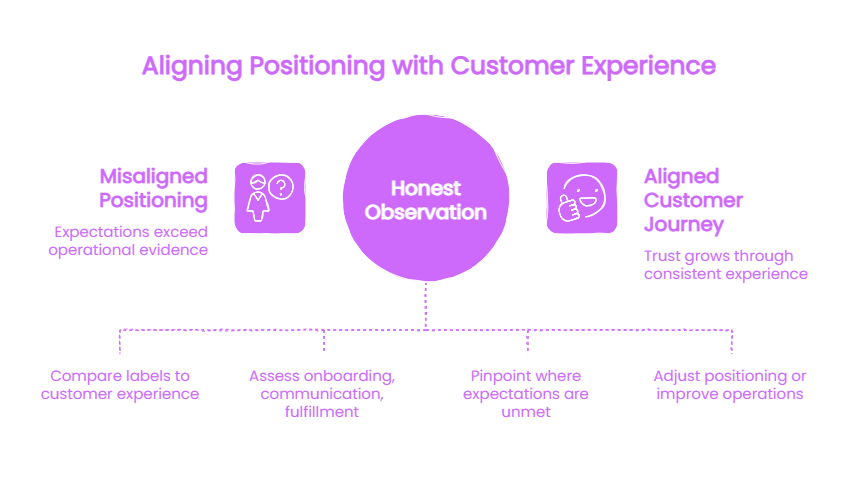
Review every positioning label currently used throughout your funnel, website, sales pages, and customer communications. Compare each classification against the actual experience customers receive after engaging with the business. Evaluate onboarding, communication, fulfillment, responsiveness, delivery quality, customer outcomes, and operational consistency without relying on marketing language alone. Identify where expectations exceed operational evidence. Separate aspirational positioning from demonstrated capability. Honest observation creates the foundation for meaningful alignment. The objective is not to diminish ambition but to strengthen credibility.
When unsupported classifications are identified, choose whether to simplify the positioning or strengthen the operations until both become consistent. Resist the temptation to compensate with stronger branding while operational gaps remain unresolved. Allow customer experience to define the classification rather than allowing terminology to define the experience. As execution improves, positioning naturally becomes more credible. Marketing begins communicating truths that customers consistently confirm for themselves. Trust grows because expectation and experience remain aligned throughout the customer journey. Strong funnels always communicate operational reality before aspirational identity.
In Closing
Customers trust businesses whose positioning accurately reflects the experience they consistently deliver. Classification establishes expectations, but operations determine whether those expectations become lasting confidence. Every interaction either reinforces or weakens the promise introduced by the offer's positioning. Businesses strengthen credibility by allowing operational evidence to define their classification rather than relying on aspirational language alone. Trust becomes sustainable because customers repeatedly encounter consistency instead of contradiction. Positioning gains authority through execution rather than persuasion. Accurate classification ultimately becomes one of the strongest forms of customer confidence.
Mislabeling creates expectation without sufficient evidence to support it. Accurate classification allows expectations and experiences to remain connected from the beginning of the customer journey through long term customer relationships. Customers recognize authenticity because operational reality consistently confirms what the business communicates. Strong funnels do not exaggerate what a business hopes to become. They accurately reveal what the business has already established through disciplined execution. Classification becomes credible because it reflects measurable operational truth. The most effective positioning is the positioning customers naturally conclude for themselves after experiencing the business.