Event Funnels vs Application Funnels: What Each Is Built to Filter
You have organized an event or opened applications, and yet when the results arrive, a quiet tension lingers. People attend or submit, but engagement feels scattered, conversations drift, and the energy you expected to build momentum seems to dissipate the moment participants leave. You tell yourself it is normal, that systems take time to respond, but the subtle frustration persists. A sense that effort and intention collided without direction. You notice the questions that remain unanswered, the decisions that never arrive, and the anticipation that never materializes into action. It is familiar, this feeling of motion without progression, of effort multiplied without meaningful return. You may have blamed timing, promotion, or audience interest, but deep down you sense the structural work is not aligned with readiness. Recognition comes first: the system is not failing by accident, and the audience is not failing either.
This moment, so quietly frustrating, is the point where clarity begins. An event funnel and an application funnel may both lead toward conversion, yet each filters at a different stage of readiness, performing distinct work within the architecture. When the wrong funnel is applied, energy is dispersed or empty, progress stalls, and the system appears to resist effort. Misalignment is not error, it is a signal that the filter and readiness are out of harmony. Understanding the structural function of each funnel allows you to recognize where movement must be created and where restraint must be applied. The work of alignment begins in observation and recognition, not in action alone. It is only from this quiet recognition that the design of flow, rather than the exertion of intensity, becomes possible.

What an Event Funnel Is Designed to Do
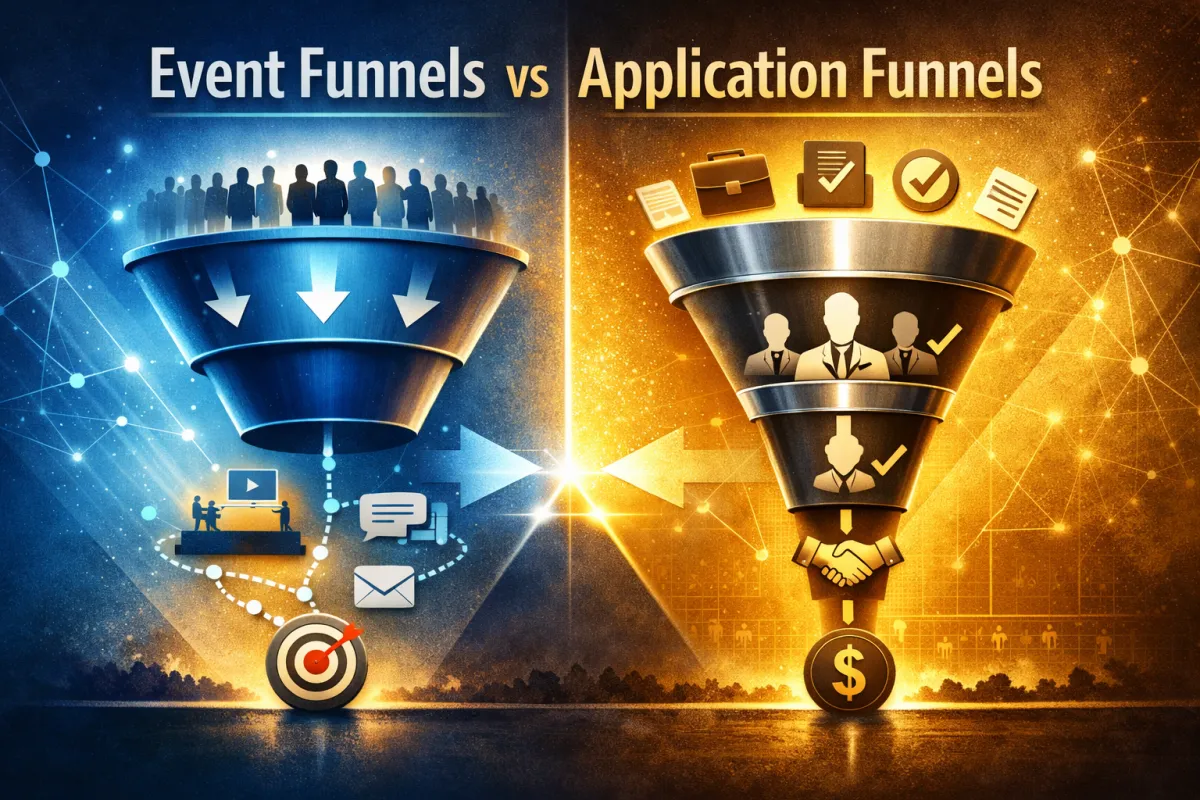
An event funnel is designed to gather broad attention and create shared experience. Its purpose is not immediate conversion, but the preparation of the audience for future action. By concentrating focus, expanding context, and building understanding over time, it gradually warms a cold or lukewarm audience to engage with your offer. Energy is invested to sustain participation and guide comprehension across stages. Performance depends on sequencing, reinforcement, and follow up, because attention alone is insufficient for movement. The audience is assumed to be at an earlier stage of readiness, and the funnel accommodates discovery and incremental understanding. Its structure is expansive, layered, and preparatory, supporting progression without forcing it prematurely.
Event funnels also increase comprehension and context before commitment. They deliver content, orientation, and insight in a way that shapes understanding gradually. Misalignment occurs when this funnel is used with highly ready audiences, producing exhaustion and wasted energy. Backend follow up is required to convert attention into action, and progression is dependent on careful orchestration rather than immediate response. Momentum emerges from the interaction of clarity, trust, and engagement over time. Volume amplifies structure, but it cannot repair gaps in readiness or context. Event funnels multiply exposure and attention, but their effectiveness is measured in preparation, not in immediate decision.

What an Application Funnel Is Designed to Do
An application funnel assumes readiness before entry. It filters participants according to established criteria, expecting that awareness, authority, and context already exist. Its function is selective, guiding evaluation and decision making with precision. Where event funnels expand attention, application funnels protect time and authority, converting only those who meet the readiness threshold. The structural load rests on clarity, credibility, and positioning, rather than on energy-intensive engagement. Misapplication to low-readiness audiences produces emptiness and stagnation. Movement occurs because the prerequisites are satisfied, not because effort alone is applied.
The work of an application funnel is evaluative and sequential. It ensures that decisions are made before entry rather than during the process, aligning engagement with readiness. Authority must be clearly established, and positioning must be stable to sustain progression. Misuse in the wrong audience creates disengagement, but this is a reflection of misalignment rather than a failure of the system itself. Evaluation is layered and deliberate, guiding the audience through decision points in a structured and measurable manner. The funnel’s effectiveness comes from filtering, sequencing, and selective progression rather than from amplification or volume. Precision governs advancement, and clarity sustains trust at every stage.

The Readiness Difference
Event funnels are calibrated for early stage readiness. They accommodate learning, orientation, and incremental engagement. The system assumes attention must be guided, comprehension must be layered, and understanding must be developed over time. Misalignment occurs when audiences are advanced, producing fatigue or redundant effort. The filter is intentionally wide to gather attention and support awareness, and progression depends on subsequent steps outside the immediate funnel. Energy and engagement are multiplied, but movement emerges only when preparation aligns with the readiness of the audience.
Application funnels operate at later stage readiness. They presuppose that context, trust, and authority have been established before engagement. Progression is expected immediately because the audience is prepared to evaluate and decide. Misalignment occurs when early stage audiences face selective filtering, producing empty activity and disengagement. The filter is narrow by design, governing advancement rather than multiplication. Movement depends entirely on readiness alignment, and structural function dictates the effectiveness of the funnel. Precision, clarity, and authority enable smooth decision making within this context.

When Misused
An event funnel applied to a high readiness audience produces exhaustion. Energy is distributed across redundant steps, attention is diluted, and participants capable of immediate decision are delayed or disengaged. Effort intensifies without producing advancement. The system operates according to design, but friction emerges because readiness has outpaced the structure. Misapplication is not visible in failure metrics alone. It is felt in subtle disengagement, scattered focus, and the inefficiency of multiplied energy without meaningful movement. Recognition of misalignment allows correction without further intensity.
An application funnel applied to a broad, early stage audience produces emptiness. Few participants meet entry criteria, and the structure functions precisely as intended, but movement stalls. Opportunities for engagement and education are lost, and the system appears inactive despite clarity and authority. Misalignment is structural, not functional. Effort alone cannot substitute for readiness and attempts to accelerate activity produce only motion without progression. The contrast between exhaustion and emptiness reveals the distinct roles of each funnel, clarifying why alignment is essential.

Why Businesses Confuse the Two
Organizations often confuse event and application funnels because pressure for results drives premature action. Trends, social proof, and imitation of competitors obscure readiness considerations. Leaders replicate structures without considering whether the audience is prepared for evaluation or still requires education and context. Copying form without matching function collapses progression and generates friction. Misalignment becomes visible only in the outcomes, yet it governs engagement and advancement from the outset.
Metrics favoring volume over structural alignment compound confusion. Leaders may interpret low attendance or low submission rates as funnel failure rather than as a reflection of readiness mismatch. Reactionary adjustments replace deliberate distinction, creating cycles of effort that do not improve movement. Structural clarity is ignored, and friction replaces flow. Recognizing the underlying principle, that funnels are filters matched to readiness prevents misdiagnosis and restores alignment between effort and outcome.

How to Choose Correctly
The correct funnel is determined by the work that must occur before sale. If the audience requires context, education, and warming of awareness, the event funnel is appropriate. If the audience has sufficient understanding, trust, and alignment to evaluate, the application funnel is appropriate. Matching filter to readiness creates natural movement, while misalignment produces friction and inefficiency. The choice is structural, not tactical, and depends on mapping readiness against the intended work of the funnel.
Decision making requires calm assessment and recognition of audience preparation. Alignment between readiness and filter restores flow and progression without additional effort. Misalignment produces wasted energy, scattered attention, or disengagement. Precision is essential, the funnel is not chosen for popularity, trend, or volume, but for structural appropriateness. When the filter corresponds to readiness, engagement is smooth, decisions are predictable, and energy is conserved. Structural alignment governs the outcome, not intensity or frequency of activity.

Closing Orientation
Funnels are filters. Filters require criteria defined by readiness, context, and authority. When the filter matches the audience’s stage, movement occurs seamlessly. When it does not, friction appears, subtle but persistent, inhibiting progression and wasting effort. The work is not in activity or energy alone; it is in structural alignment. To operate with precision is to honor both system and audience. Flow, engagement, and advancement emerge not from effort but from distinction. Knowing what must be gathered, what must be evaluated, and when each step is rightly applied.