
Color Without Function: When Aesthetics Disrupt Clarity
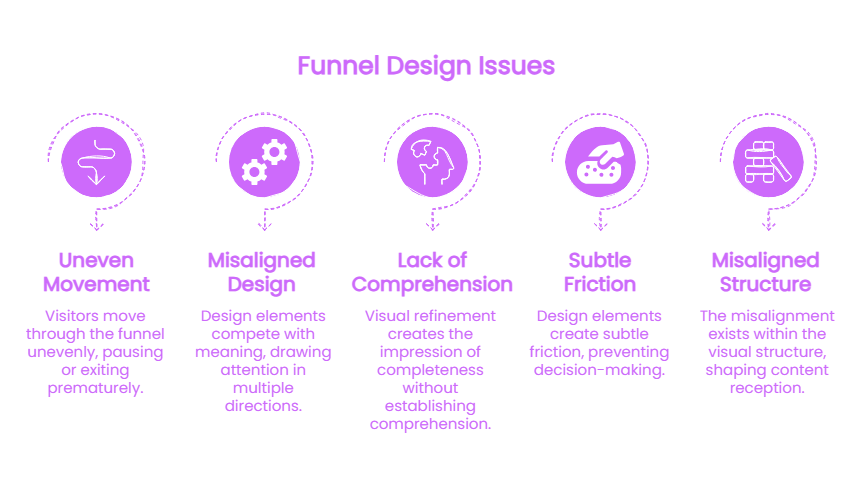
When a funnel is built with care, the expectation is that refinement will translate into movement. The visual presentation appears elevated, the layout feels intentional, and the experience seems complete. Yet engagement does not follow a consistent path. Visitors move through the funnel unevenly, pausing where they should proceed and exiting where they should decide. The instinct in response is to adjust messaging, reconsider targeting, or strengthen the offer itself. These adjustments assume that the issue lies in what is being said or who it is being said to. What often remains unexamined is how the funnel is visually directing, or failing to direct, understanding. The issue is not the presence of design, but the absence of functional alignment within it.
A funnel can appear polished while remaining structurally unclear. Visual refinement can create the impression of completeness without establishing comprehension. When design elements are introduced without a defined role, they begin to compete with meaning rather than support it. Attention is drawn in multiple directions, and the reader must determine where to focus rather than being guided. This creates subtle friction that is not immediately attributed to design. The funnel feels active but does not produce decision. The misalignment exists within the visual structure itself, shaping how the content is received. Until this is recognized, adjustments will continue to target the wrong layer.
What Aesthetic Interference Actually Is
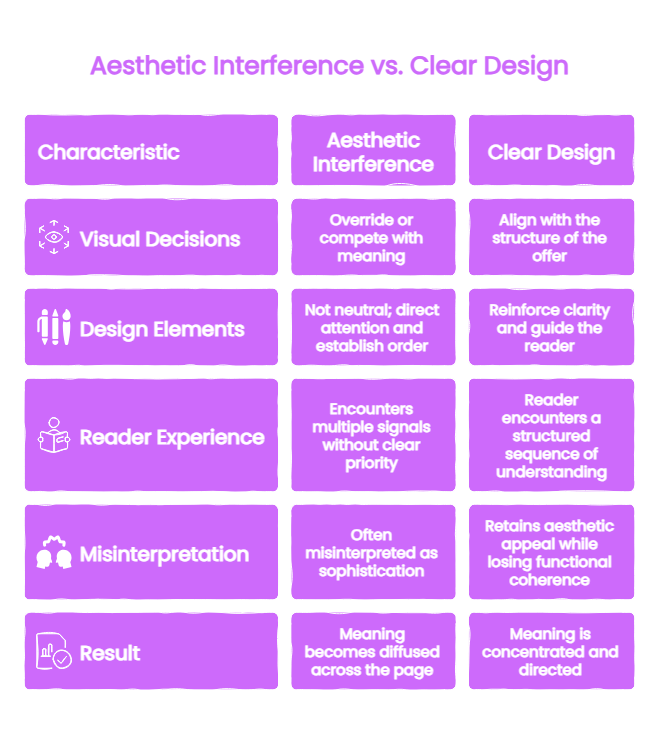
Aesthetic interference occurs when visual decisions override or compete with meaning. Design elements such as color, spacing, layout, and hierarchy are not neutral. They direct attention and establish order. When these elements are aligned with the structure of the offer, they reinforce clarity and guide the reader through a coherent path. When they are not, they fragment comprehension. The reader encounters multiple signals without a clear indication of priority. Meaning becomes diffused across the page instead of concentrated and directed. The funnel begins to function as a collection of visual choices rather than a structured sequence of understanding.
This form of interference is often misinterpreted as sophistication. Layers of design are added to create depth, variation, or distinction, but without a governing structure, these layers compete. The reader must determine what is primary and what is secondary without guidance. Visual emphasis shifts unpredictably, and the relationship between elements becomes unclear. The funnel retains aesthetic appeal while losing functional coherence. What appears refined at a surface level disrupts clarity at a structural level. The result is a funnel that is visually engaging but cognitively unstable.
What It Looks Like in Practice
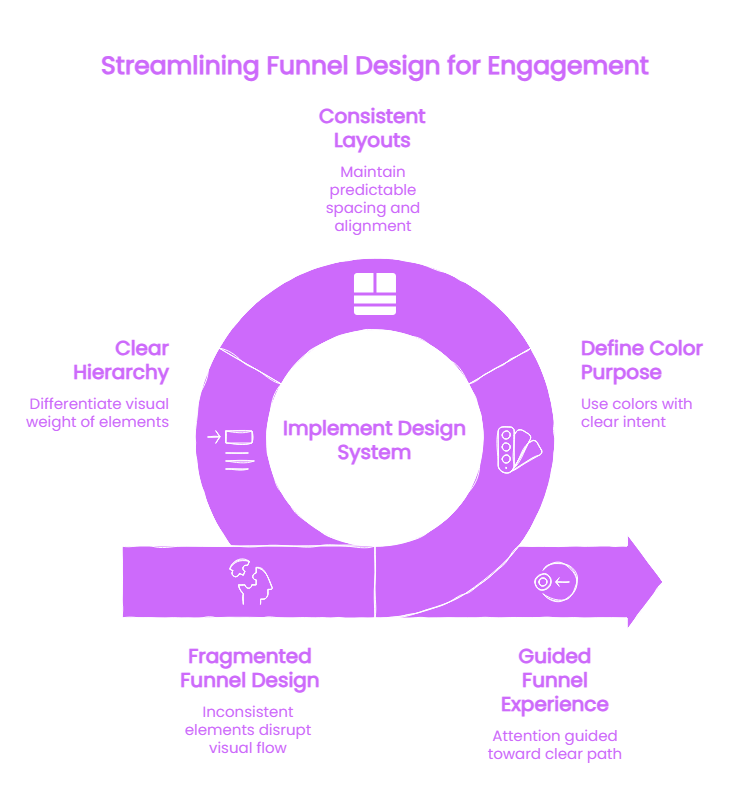
Aesthetic interference is visible in the composition of the funnel itself. Pages may contain multiple colors used without defined purpose, creating competing areas of emphasis. Layouts may shift unpredictably, with inconsistent spacing and alignment that disrupt visual flow. Hierarchy is often unclear, with headlines, subheadings, and calls to action carrying similar visual weight. The reader’s attention is drawn in several directions at once, without a clear path to follow. Each element may be individually well designed, but collectively they do not function as a system. The result is engagement without direction.
This fragmentation produces a specific experience for the reader. Attention is captured but not guided, leading to scanning without comprehension. The reader may revisit sections, pause longer than expected, or disengage entirely. Visual cues that should signal importance instead compete for recognition. The absence of a dominant focal point forces the reader to interpret structure on their own. Cognitive effort increases as clarity decreases. The funnel appears active, yet movement toward decision is inconsistent.
How Funnels Reveal This Distortion
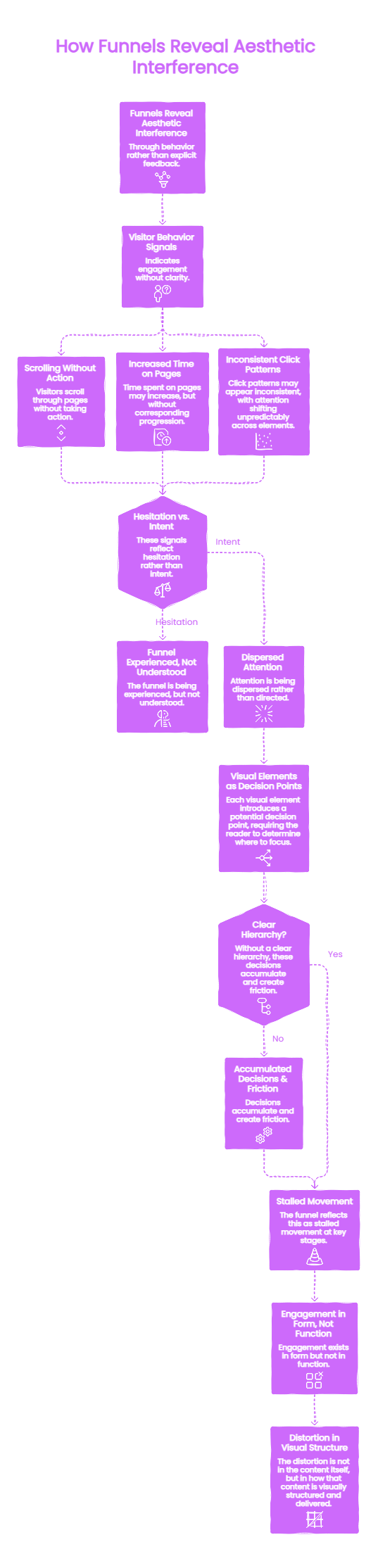
Funnels reveal aesthetic interference through behavior rather than explicit feedback. Visitors may scroll through pages without taking action, indicating engagement without clarity. Time spent on pages may increase, but without corresponding progression. Click patterns may appear inconsistent, with attention shifting unpredictably across elements. These signals reflect hesitation rather than intent. The funnel is being experienced but not understood.
This pattern indicates that attention is being dispersed rather than directed. Each visual element introduces a potential decision point, requiring the reader to determine where to focus. Without a clear hierarchy, these decisions accumulate and create friction. The funnel reflects this as stalled movement at key stages. Engagement exists in form but not in function. The distortion is not in the content itself, but in how that content is visually structured and delivered.
Why More Design Doesn’t Fix It
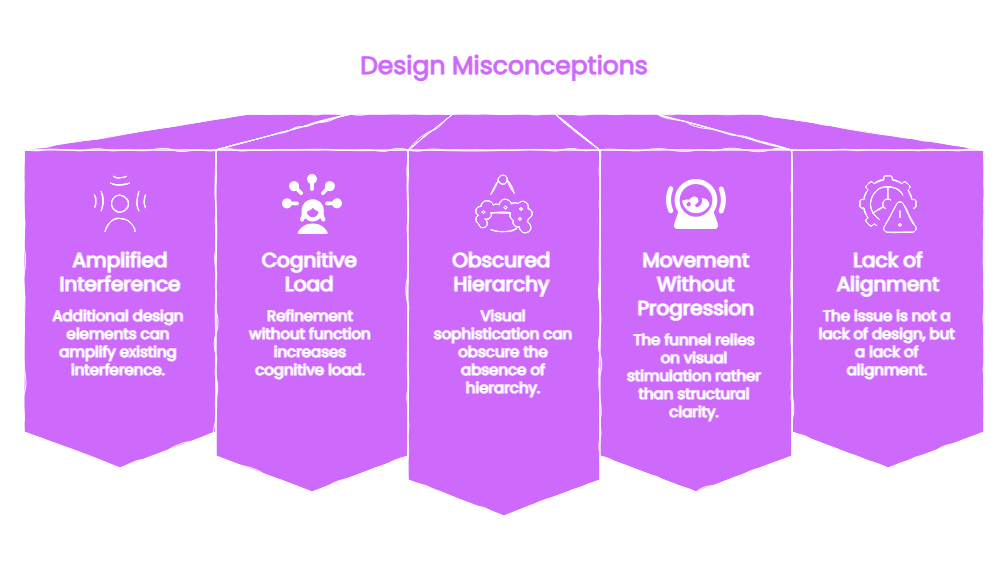
The response to underperformance often involves increasing the level of design. Additional animations, refined graphics, and expanded visual elements are introduced in an effort to enhance engagement. These changes assume that more design will produce more clarity. In practice, they often amplify the existing interference. Each new element adds another layer of visual input without resolving the underlying misalignment. The funnel becomes more complex while remaining unclear.
Refinement without function increases cognitive load. The reader must process more information without gaining additional understanding. Visual sophistication can obscure the absence of hierarchy and direction. The funnel begins to rely on visual stimulation rather than structural clarity to sustain engagement. This creates movement without progression. The issue is not a lack of design, but a lack of alignment between design and meaning. Without this alignment, additional design compounds the problem rather than resolving it.
Where Visual Clarity Must Be Established
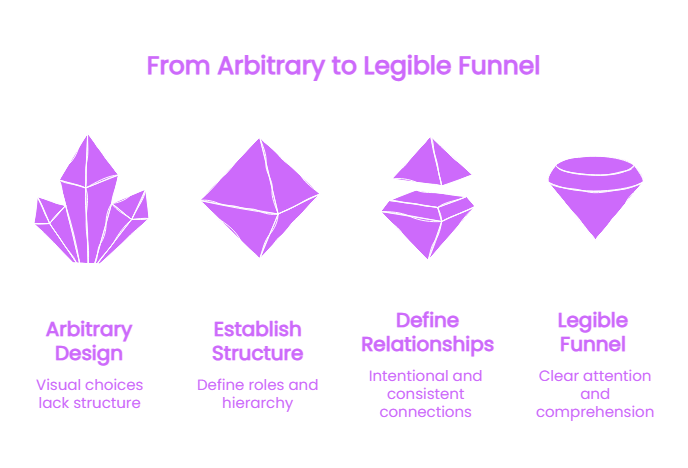
Visual clarity must be established as a structural principle rather than an aesthetic preference. Design exists to guide attention, define hierarchy, and reinforce meaning. Each element within the funnel must have a defined role within this structure. Primary actions must be visually distinct, and supporting elements must remain subordinate. The relationship between elements must be intentional and consistent. Without this structure, visual choices remain arbitrary.
When visual clarity is established, the funnel becomes immediately legible. The reader understands where to look, what to prioritize, and how to move forward. Attention is directed rather than dispersed, and comprehension occurs without effort. The design no longer competes with the content, it supports it. Movement through the funnel aligns with intention because the structure is visible. Clarity is not added through decoration but revealed through alignment.
Working With the Funnel
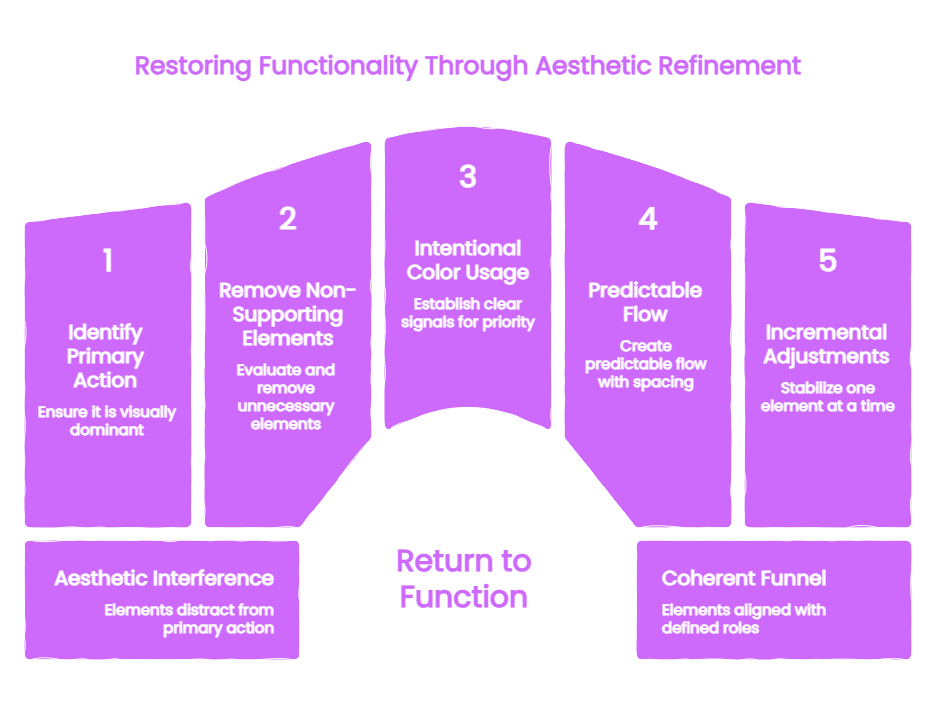
Working with aesthetic interference requires a return to function. The first step is to identify the primary action on each page and ensure it is visually dominant. All elements that do not support this action must be evaluated and, if necessary, removed. Color should be used with intention, establishing clear signals for priority and interaction. Spacing and layout should create a predictable flow that guides the reader naturally. The objective is not reduction for its own sake, but alignment of every element with a defined role.
Observation becomes the method of refinement. Attention should be tracked to determine where it naturally moves and where it stalls. Points of hesitation indicate areas where visual hierarchy is unclear. Adjustments should be made incrementally, stabilizing one element at a time. The funnel must be allowed to reveal its structure through behavior. As interference is removed, clarity emerges. The result is not a simpler funnel, but a more coherent one.
In Closing
Design directs perception. When it is aligned with structure, it clarifies meaning and guides action. When it operates without function, it fragments attention and disrupts comprehension. A funnel does not require more design to perform effectively. It requires design that is governed by purpose. Function must lead, establishing the framework within which aesthetics operates.
When aesthetics lead without function, the funnel becomes visually compelling but structurally unstable. Engagement may increase, but decision making does not follow. The reader remains in a state of interpretation rather than understanding. When function leads, design becomes an instrument of clarity. The funnel stabilizes, movement aligns, and decisions occur without friction. The distinction is not in how the funnel looks, but in how it directs.